Classic of the week: FARGO or the Coen brothers’ For Whom the Bell Tolls.

Fargo

Jerry Lundegaard is in need of money and has set in motion a plan to let ‘two professionals’ kidnap his wife. His rich father in law will have to come up with the ransom money which Jerry can ‘divvy up’ with the kidnappers. At least, that’s the plan. Blood will be shed.
A pregnant police woman (a delightful Frances McDormand in an Oscarwinning role) will get on the snowy and bloody trail of the criminals at her own leisurely pace being as much occupied with finding food and hotel rooms at reasonable prices as with catching the bad guys.

Movie buffs will notice plenty of references to other movies such as to Edgar G. Ulmer’s Detour (the telephone cable being pulled underneath a door opening), Psycho (the ripping of the shower curtain), The Shining (the force opening of the bathroom door + the opening of the bathroom window), and to their very own film Blood Simple (the deserted highway at night with a character holding a dead body while suddenly in the distance a vehicle approaches) and so on.

I could go on forever discussing the different aspects of this film. The black humour, the great writing, the wonderful characters (e.g. the scene with former classmate Mike Yanagita), the acting, Roger Deakins’ photography trying to keep the snow landscapes interesting and at times deliberately creating confusioning shots that initially make it hard to determine if you’re looking up or down. The use of the Midwestern accent (good luck if you’re trying to count all the yah’s) and its distinct way of expressing accompanied with a particular sense of niceness.

I’ll just point out a couple of small details that exemplify The Coen brothers peculiar sense of humour which makes every repeat viewing of their films so worthwhile.
1) Every time somebody is about to die in the film you can hear some kind of a ringing or bell sound. E.g. the sound of a car door or trunk which is ajar just before someone gets shot or of the tiny bells on the edge of a woolen hat of a character just about to axe someone. For Whom the Bell Tolls?
2) The Coen brothers asked the props department to put little statuettes of pigs all over the house of the Lundegaard family. Why? To see if the critics would spot them and see if they would come up with some interesting theories as to why they did it. Have fun spotting the pig statuettes in the below clip.

Jan Bollen

STAR WARS: THE FORCE AWAKENS: The old magic strikes back.

The Force Awakens

I promise I won’t give away any plot points, I won’t even give away the names of the new characters, so no spoiler alert. I’ll just sum up the basic premise form the opening credit roll as short as possible. The new baddies are now part of the FIRST ORDER and everybody is looking for Luke Skywalker who has disappeared.

The film starts about 30 years later where the Return of the Jedi episode left off with introducing all the new characters and the new storyline and sporadically gives nods to the original trilogy. Certain images and situations will certainly have a familiar feel. For instance you’ll notice some familiar looking debris in the desert. It will be no surprise that the main characters of the original trilogy, Han Solo, Chewbacca, Princess (or now General) Leia, C3PO and R2D2 pop-up.

The Force Awakens goes back to the magic of the original trilogy and director J.J. Abrams does so very successfully. The main negative point is that the nods to the previous films start of subtle but they turn into big winks and the entire plot line becomes somewhat of a rehash of episodes IV to VI, mainly of episode IV A New Hope. But don’t be alarmed as you’ll have a great time watching episode VII as it’s as good as you can expect and it gives you everything you were hoping for and then some. And to be honest all the nods and winks are what make the film so enjoyable.

Visually the film cleary continuous using the Nazi iconography for the bad guys as it was introduced in the original film with the Darth Vader helmet and the lining up of the star troopers and now also adds the typical Nazi red, white and black colorscheme to the mix, most noticeably in the scene where the general -played by Domhall Gleeson- addresses the star troopers before initiating an intergalatic holocaust.

Fans of The Raid 1 & 2 will definitely appreciate the (all too brief) appearence of its stars Iko Uwais & Yayan Ruhian. Max von Sydow, the iconic Ingmar Bergman actor, also shows up briefly.

With actors such as Oscar Isaac, Daisy Ridley, Adam Driver providing new blood and a bunch of the original cast and with directors Rian Johnson (Brick, 2005, Looper, 2012) and Colin Trevorrow (Safety not Gauranteed, 2012 and Jurassic World, 2015) in the wings to direct episodes VIII and IX Star Wars fans can sleep on both ears as the series are in good hands.
The new Disney produced Star Wars series is off to an great and entertaining start of the highest, or perhaps better, FIRST ORDER.

Jan Bollen

ABCs OF DEATH 2. Another 26 deaths one for each letter of the alphabet.

ABCs2

As was the case with the previous film we again get to see 26 short films by 26 directors from around the world. Each director was given a letter of the alphabet and asked to choose a word. They then created a short tale of death that related to their chosen word. They had complete artistic freedom regarding the content of their segments.
This time every segment starts and finishes with something black in the frame (as apposed to red in the first anthology).

All though the second ABCs of Death was better received I must admit I like the first one better. It had more completely outrageous segments, whereas the second compilation has too many tame or silly ones. Most of the directors are young, some have only made a few short films or have one or two features under their belt.
There are a couple of more seasoned directors such as the famous animator Bill Plympton (I Married a Strange Person!, 1997 and Hair High, 2004) and Larry Fessenden (an all rounder whose films No Telling, 1991 and Habit, 1995 can be seen regularly on Sundance Channel).

The first three short films Amateur, Badger and Capital Punishment are British segments, especially the first two are very funny and get the film of to a good start and Capital Punishment gets some first real horrific images on the screen.
My favourite segments were Equilibrium where 2 friends are stranded on a desert island when suddenly a beautiful woman washes ashore which results in some priorities that need to be set straight, and Xylophone that starts with a grandmother wathcing her granddaughter play the xylophone and ends with the grandmother playing a ‘similar instrument’.

A few of the directors have already made excellent features and are to be kept on eye in the future such as Kristina Buožytė whose Aurora (a.k.a. Vanishing Waves, 2012) was one of THE surprises of that year, and the Israeli duo Aharon Keshales & Navot Papushado of the interesting Kalevet (a.k.a. Rabies, 2010) and Big Bad Wolves (2013) which was highly recommended by Quentin Tarantino.

Below you can find the full list of titles and directors of the second ABCs of Death anthology:

  • A is for Amateur (directed by E.L. Katz)
  • B is for Badger (directed by Jullian Barratt)
  • C is for Capital Punishment (directed by Julian Gilbey)
  • D is for Deloused (directed by Robert Morgan)
  • E is for Equilibrium (directed by Alejandro Brugués)
  • F is for Falling (directed by Aharon Keshales and Navot Papushado)
  • G is for Grandad (directed by Jim Hosting)
  • H is for Head Games (directed by Bill Plympton)
  • I is for Invincible (directed by Erik Matti)
  • J is for Jesus (directed by Dennison Ramalho)
  • K is for Knell (directed by Kristina Buožytė and Bruno Samper)
  • L is for Legacy (directed by Lancelot Oduwa Imasuen)
  • M is for Masticate (directed by Robert Boocheck)
  • N is for Nexus (directed by Larry Fassenden)
  • O is for Ochlocracy (mob rule) (directed by Hajime Ohata)
  • P is for P-P-P-P SCARY! (directed by Todd Rohal )
  • Q is for Questionnaire (directed by Rodney Ascher)
  • R is for Roulette (directed by Marvin Kren)
  • S is for Split (directed by Juan Martinez Moreno)
  • T is for Torture Porn (directed by Jan and Sylvia Soska)
  • U is for Utopia (directed by Vincenzo Natali)
  • V is for Vacation (directed by Jerome Sable)
  • W is for Wish (directed by Steven Kostanski)
  • X is for Xylophone (directed by Julien Maury and Alexandre Bustillo)
  • Y is for Youth (directed by Soichi Umezawa)
  • Z is for Zygote (directed by Chris Nash)

Jan Bollen

THE ABCs OF DEATH. Horror anthology A-Z.

ABCs

This horror anthology starts of with an opening card stating: The following feature film was created by 26 directors from around the world. Each director was given a letter of the alphabet and asked to choose a word. They then created a short tale of death that related to their chosen word. They had complete artistic freedom regarding the content of their segments.
Since the film, including opening and closing credits, has a duration of 129 minutes the directors off course only had a limited amount of time to tell their story. Another constriction appears to be that the beginning and ending of every segment had to be filled with something red.

An anthology or omnibus film is a feature film that consists of a series of short films usually directed by different directors with a common theme (Les Sept péchés capitaux, 1962 & 1992), location (New York Stories ,1989, Four Rooms, 1995, Paris je t’aime, 2006, Tokyo!, 2008) or story as a framing device (Dead of Night, 1945).  The very nature of this type of film is that the segments tend to vary in quality and the tone shifts do not make it easy for the viewer to experience the result as a single film.

Discussing all 26 short films would take forever + would ruin most films due to the fact that the premise in most cases makes up for 99% of the film. The film starts of great with Apocalypse that succesfully plays with the audience’s expectations. There’s an excellent animation Klutz (Anders Morgenthaler, known for Princess 2006) and a great clay animation Toilet. My other favourite segments were Dogfight, Orgasm (in the typical pure cinema style and soundtrack from the couple Cattet & Forzani) and -perhaps my favourite of the bunch, the most voilent and poignant one- XXL dealing with our obsession with the perfect body and the negative influence of commercials to this effect.
Theres were some great, rather extreme chapters from asian directors Libido and  Zetsumetsu (Extinction). The latter is an outrageous homage to the sexual innuendos in Stanley Kubrick’s Dr. Strangelove.

Below you can find the full list of titles and directors which includes some brilliant helmers such as Ben Wheatley (a.o. Sightseers, A Field in England) and Srđan Spasojević (known for the notorious Srpski film, a.k.a. A Serbian Film, 2010)

  • A is for Apocalypse (directed and written by Nacho Vigaldo)
  • B is for Bigfoot (directed and written by Adrian Garcia Bogliano)
  • C is for Cycle (directed and written by Ernesto Diaz Espinoza)
  • D is for Dogfight (directed and written by Marcel Sarmiento)
  • E is for Exterminate (directed and written by Angela Bettis)
  • F is for Fart (directed and written by Noboru Iguchi)
  • G is for Gravity (directed and written by Andrew Traucki)
  • H is for Hydro-Electric Diffusion (directed and written by Thomas Malling)
  • I is for Ingrown (directed and written by Jorge Michel Grau).
  • J is for Jidai-geki (Samurai Movie) (directed and written by Yûdai Yamaguchi)
  • K is for Klutz (directed and written by Anders Morgenthaler)
  • L is for Libido (Directed and written by Timo Tjahjanto)
  • M is for Miscarriage (directed and written by Ti West)
  • N is for Nuptials (directed and written by Banjong Pisanthanakun)
  • O is for Orgasm (directed and written by Bruno Forzani and Héléne Cattet)
  • P is for Pressure (directed and written by Simon Rumley)
  • Q is for Quack (directed and written by Adam Wingard and Simon Barrett)
  • R is for Removed (directed and written by Srđan Spasojević)
  • S is for Speed (directed and written by Jake West)
  • T is for Toilet (directed and written by Lee Hardcastle)
  • U is for Unearthed (directed and written by Ben Wheatley)
  • V is for Vagitus (The Cry of a Newborn Baby) (directed and written by Kaare Andrews)
  • W is for WTF! (directed and written by Jon Schnepp)
  • X is for XXL (directed and written by Xavier Gens)
  • Y is for Youngbuck (directed and written by  Jason Eisener)
  • Z is for Zetsumetsu (Extinction) (directed and written by Yoshihiro Nishimura)

Jan Bollen

LES COWBOYS.

les-cowboys

During a gathering of the Cowboy scene in France daughter Kelly disappears into thin air without any apparent reason. To their surprise their daughter has feld with her secret boyfriend Ahmed to Syria.
The gobsmacked father Alain (a convincing atypical role for comedic actor François Damiens) starts an obsessive search to bring back his daughter. Initially he’s accompanied by his son (an excellent Finnegan Oldfield you may know from the sadly somewhat overlooked films La Marche, a.k.a. The Marchers, 2013  and Ni le ciel ni la terre, a.k.a. The Wakhan Front, 2015).
The premise sounds very present-day, therefore you may be surprised that -as per a banner you can see in the opening country festival- the story starts in 1994 and not in more contemporary times.

First time director Thomas Bidegain, up to now known as a screenplay writer a.o. for Jacques Audiard (Un Prophète, De rouille et d’os and Dheepan) Joachim Lafosse (A Perdre la raison and the upcoming Les Chevaliers blancs) and the next Michaël R. Roskam picture Le fidèle (The Faithful), mixes elements from classic westerns, mainly John Ford’s The Searchers (1956) and transposes the classic ‘culture’ clash between cowboys and indians to the clash between the western -mostly- secularised democratic society versus the -in part- radicalised islamic society and draws conclusions that may surprise many an audience.

The film works surprisingly well, has been excellenty cast (John C. Reilly as L’Américain is a joy to watch, Sam Louwyck comes across very well as a forger of documents) and the typical western elements are subtly integrated in the story line and didn’t feel forced at all. Due to the recent events in Paris the film will probably be perceived/ addressed differently than if it would have been released 2 months earlier but in my opinion it would be silly to do so. Life doesn’t always imitate art or vice versa and it does not make the film less poignant.

Jan Bollen


HE NAMED ME MALALA. An Inconvenient Educational Truth.

Ha Named me Malala.

Davis Guggenheim best known for his Oscar winning An Inconvenient Truth (2006) about global warming has now made a documentary about Malala Yousafzai the famous young Pakistani activist advocating the female right for education.

The doc shows her activities as an anonymous blogger for the BBC after the Taliban banned girls from attending school. Inspired by her father she turned to public activism which made her a target for the Taliban who did eventually made an assassination attempt on her life on 09oct12  when she was riding home on a schoolbus. She received a bullet in the head but survived. Several days later she was brought to the UK for additional medical treatment and has since been living in Birmingham and in 2014 became the youngest ever recipient of the Nobel Peace Prize.

You may very well be aware of most of the highlights of Malala’s life and the film at times is a bit repetitive in presenting them to be able to reach a length of 88 minutes to  justify a theatrical release.
We do get to see footage of the girl behind the inspirational icon she has become that show her as an ordinary teenager who has crushes on sports idols such as Roger Federer and gets into ‘loving fights’ with her brothers and other stuff regular teenagers struggle with.
Some potentially interesting scenes such as her mothers problems with adapting to her new environment and having to learn English could have been longer. I would have liked to have seen more of her discussing the potential danger for future radicalastion due to the US drone attacks on Pakistan with Obama.

It’s not the most critical documentary you’ll every get to see and it’s clearly intended soly to be a source of inspiration with a lot of uplifting mantras like “When you educate a girl, it changes our world” and “Let us pick-up our books and our pencils. They are our most powerful weapon.”
It’s a bit of an irony that Malala who was named by her father after a Malalai of Maiwand a national folk hero of Afghanistan who rallied local fighters against the British troops and was killed by them is now living in England.
An even bigger irony is that Malala’s current life among the celebrities and her travels around the world giving numurous speeches like the one at the UN seems to be interfering somewhat with her eduction.

Jan Bollen

BY THE SEA. Mr.& Mrs. Brad and Angelina Jolie Pitt.

By the Sea

A couple (played Brad and Angelina Jolie Pitt) with marital problems retreat to Malta to a beautiful old hotel in an idyllic beach setting in the early seventies (the Watergate scandal is in the news). He is a writer who hopes to overcome his apparent writer’s block, she is a former dancer. They both have an alcohol problem the result of some unspoken drama they fail to address.

When they encounter a young couple (played by Mélanie Laurent and Melvil Poupaud) who are staying in the room next door they recognise the passion they used to feel as well. A spy hole that gives them a look into the bedroom of the lovebirds reunites them as a couple, be it a couple of voyeurs. Will this proof to be a good basis for a renewal of their relationship?

By the Sea is the third film directed by Angelina Jolie. Her debut In the Land of Blood and Honey (2011) was an extremely though film about the war in Bosnia and Herzegovina that pulled no punches that was considered by some as a vanity project but was in fact an impressive low budget film.
Her second Unbroken (2014) was a huge box office success (but was snubbed by the Academy) based on the unbelievable real-life story of Luis Zamperini which had an amazing first half but was ruined by an incredibly silly patriotic second half.

With By the Sea Jolie returns to a more low budget, arthouse film territory. The film is certainly not as bad as the bashing reviews and audience reactions in the States would let you to believe but it’s not necessarily a masterpiece either. They did however choose a strange project to celibrate their honeymoon with.
The photography by Christian Berger (worked 5 times with Michael Haneke including Benny’s Video, 1992 and Das Weiße Band a.k.a. The White Ribbon, 2009) is excellent. The film might have been better served by not explaining the unspoken drama towards the end but this would probably have frustrated and infuriated people even more. But those who were expecting Mr. & Mrs. Smith part II were never going to be satisfied by this moodier piece anyway.

Jan Bollen

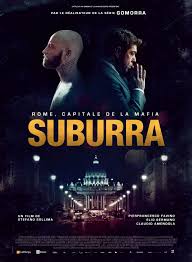
SUBURRA. Excellent Italian gangsterfilm + future Netflix series

Suburra

Suburra refers to a suburb of Acient Rome and was the title of the novel by Carlo Bonini and Giancarlo De Cataldo on which this film by Stefano Sollima is based. And in case you’re wondering, Stefano is indeed the son of Sergio Sollima (1921-2015), one of the three Sergio’s that were famous for their Spaghetti westerns, the others being Sergio Leone and Sergio Corbucci.

Set in november 2011, the ‘Southern Families’ of the maffia are planning on building the New Las Vegas on the shores of Ostia. An Old School maffioso called ‘Samurai’ (potentially a Jean-Pierre Melville fan) is the man that needs to ensure everybody  stays in line so nothing will prevent the multibillion future cash-cow project from happening.
The Vatican is involved and so is politician Fillipo Malgradi (an excellent Pierfranscesco Favino). When the corrupt Malgredi has a private crack-infused ‘bunga bunga’ with 2 prostitutes of which one is underaged the wheels of fate are set in motion. A countdown of 7 days that will lead to ‘the apocalypse’ has started.

Yet another Italian gangster film you might say and yet it’s a good one. It’s difficult to remain original in a genre that has had many a highlights in the past and in more recent years.
Suburra goes less the realistic docu style way of Gomorra (although there’s some of that as well) but more the architypical way of a Michael Mann. The doomed gangsters looking at a beach behind a big glass window and way the music of M83 is used repeatedly and extremely loud is very reminiscent of Mann. A scene that certainly stands out is the shootout that starts on a back exit stairway of a supermarket and continues in a shopping mall.
The plot is very well set-up and each character gets ample time to play out it’s well-measured role.

By the way Netflix has started production on a TV-series to be aired in 2017 if it’s anything like the film it’s certainly something to look forward to.

Jan Bollen


IN THE HEART OF THE SEA (3D). The story that was the inspiration for Moby-Dick.

In the heart of the Sea

The film is based on Nathaniel Philbrick’s In the Heart of the Sea: The Tragedy of the Whaleship Essex and tells the true story behind the famous novel Moby-Dick by Herman Melville. The film starts with Herman Melville (Ben Whishaw) paying Tom Nickerson (Brendan Gleeson) a handsome sum -basically all the money he has left- to hear him tell his real-life story of what happened on the Essex and in particular their encounter with a gigantic white whale.

What follows are flashbacks showing the very stereotypical rivalry between second in command Owen Chase (Chris Hemsworth reteaming with director Ron howard after the excellent Rush, 2013) and captain George Pollard intercut with scenes of Melville eagerly writing down Nickersons’ tales.
At first Chase and Pollard agree to disagree and are focussing on accomplishing their mission as soon as possible: filling 2000 barrels with oil ‘collected’ from harpooned whales as soon as possible, collect the money and go their separate ways. Untill a giant white whale is crossing their path and sheer survival becomes the order of the day.

The film is very well made, the 3D is not bad but not exceptional either, and the visual effects are very convincing. But that’s the least you can expect from an expensive blockbuster. It’s a good, somewhat old fashioned adventure film with rather simplistic black and white characterisations which somehow never really gives you the impression you’re watching something truly exceptional.

Jan Bollen


VIOLET. Impressive debut by Bart Devos.


We see 2 groups of 2 teenagers on a CCTV (Closed Corner Television) of a small shopping center. One of the teenagers is being attacked. Jesse -who sees his friend Jonas being stabbed and die in front of his eyes- appears  nailed to the ground, unable to react. Suddenly the image starts to rewind and we realise we have been watching these images with several police officers who are investigating the footage that captured the tragic events. We sense a similarity to the Joe Van Holsbeeck killing.

Jesse who’s part of a close group of BMX riders (as was Jonas) has to deal with his own feelings of guilt and with the questions of the rest of the group and his and Jonas’ family.
The film is really a mood piece thriving on atmosphere using a lot of long sequences shots, many of which are cheer magic.  The shot were the camera follows the BMX kids slowly riding in a calm neighbourhood, constantly shifting focus. The shots of them riding and jumping on a track in a forest, following them when they are in the back of a pick-up truck and get on a highway, … . Extremely impressive.

In interviews Bart Devos -who made his feature length debut with Violet- never reveals his inspirations but his film has often been compared with the work if Gus Van Sant and Béla Tarr.
As Violet owes a lot to it’s DoP Nicholas Karakatsanis I believe that the film is at least as much inspired by the work of Gus Van Sant’s regular DoP Harris Savides (1957-2012) then by Van Sant.
It would be interesting to compare the scene in Jonathan Glazer’s Birth (2004), which was shot by Savides, of the arrival in the opera of the character played by Nicole Kidman shortly after she had a somewhat traumatic experience, with a similar scene in Violet during a concert of the black metal band Deafheaven. Both scenes are shot in one single long take in which the camera slowly moves in on the main character to reveal their emotional devastation. No way this shot from Birth wasn’t on the director or the DoP’s mind when they were shooting Violet.

The danger with long sequences shots is that if they do not work the film really falls flat for a moment which luckily does not happen that often. The film is very spare with dialogue and it’s lack of explanation may well alienate or frustrate a large section of the audience.
For me the weakest moments in the film are those when Jesse visits Jonas’ father and we get some Tarkovsky like ‘it’s raining on the inside of a house symbolising the presence of a holy spirit’ scenes which have a really heavy and pretentious feel to them which I’m not a particularly big fan of. But when it works we get to see some magical and original cinematic moments.

Jan Bollen