BLACK MASS. Blue-eyed gangster Johnny Depp Straight Outta Boston.

Black Mass

When you look at the poster you might think Johnny Depp went back to his Hunter S. Thompson (or Raoul Duke) look from Fear and Loathing in Las Vegas but in fact he’s portraying a legendary Boston gangster called James “Whitey” Burger. The character Frank Costello that Jack Nicholson played in The Departed was modelled after Bulger.
With the prosthetics and blue eyes it may take a few seconds before you realise it’s Depp. There’s a faint resemblance between Depp’s Bulger and Ed Harris (perhaps due to State of Grace?)

The film zeroes in on Bulger’s ‘business arrangement’ with FBI agent John Connolly (Joel Edgerton), a childhood acquaintance. He helps out with interesting tips on the Italian maffia and in exchange Bulger and his Irish gang can go ahead unhindered with their ‘activities’. Both ‘careers’ benefit heavily from this deal, until … .

The list of supporting actors is impressive: Benedict Cumberbatch Kevin Bacon, Peter Sarsgaard (this week also starring in Pawn Sacrifice), Adam Scott, Corey Stoll (Peter Russo in House of Cards) and Juno Temple in a brief but very notable performance.
But basically it’s the Johnny Depp show, be it a somewhat more restraint one, to showcase Depp can play a scary character and to openly apply for an Acadamy Award nomination. The ‘secret family recipe’ scene is definitely inspired by the famous “I’m Funny how?” scene from Goodfellas that got Joe Pesci his Oscar.

Scott Cooper (Crazy Heart, Out of the Furnace) is an adequate director but does not have the visual brilliance or the extreme attention to detail of a Scorsese or the finesse of a Sidney Lumet to really raise this gangster, police corruption docu drama to the high standard of a Goodfellas or a Prince of the City.

Jan Bollen

VIVRE SA MORT. Confrontational doc about euthanasia.

Vivre sa mort

Manu Bonmariage is a documentary filmmaker best known for his contributions to the popular RTBF doc. series ‘Strip-Tease’ and a couple of feature films. Occasionally one of his documentaries hits the movie theaters, like Les amants d’assises (Lovers on Trial, 1992) or earlier this year Vivre sa mort (Living once Death, 2015).

Bonmariage follows two men in their sixties who both have been diagnosed with terminal cancer. We get to see them in the final stages of their lifes being confronted with their imminent death. They both opt for euthanasia.

The first man Philippe Rondeux is a patient in a catholic hosipital whose doctor keeps avoiding to confirm if he’ll help with his request in the end. The other man Manu de Coster is a surgeon himself and has arranged everything to the last detail with his fellow colleagues.

Vivre sa mort airs on Canvas this sunday 29 november 2015 starting at 21h50. I guess by now you’ve realised that if you decide to watch it you won’t have a casual entertaining evening with a lot of laughs. Confrontational as it may be, it really is a must see documentary which you’ll never ever forget and which will confront you to think about questions you’ll sooner or later may/will have to answer yourself.

Jan Bollen

AUTÓMATA. Good ideas put on autopilot.

Automata

Gabe Ibáñez’s (Hierro) Autómata was shown this year at the Brussels International Festival for Fantastic Films (BIFFF) but was not released theatrically in Belgium.

The film starts of with quite an extensive on screen exposition setting up it’s premise: It’s 2044 AD,  solar storms have killed 99.7 % of the world’s population and only 21 million people survived. The survivors have designed and built robots called Automata Pilgrims to help to rebuild the world. These robots have two security protocols; they can neither harm humans nor alter themselves or other robots.

Antonio Banderas plays an insurance investigator who has to check-up on owners claims of malfunction of their Automata robots which always turn out to be false. All of a sudden a robot is found who’s clearly trying to repair and even make improvements on himself showing a remarkable intelligence.

The film is clearly inspired by famous predecessors, both in film and in Sci-Fi literature. The opening images are pure Blade Runner and Sci-Fi experts have pointed out that the 2 protocols are derived from Isaac Asimov’s (a.o. I Robot) ‘Three Laws of Robtics’:

  • A robot may not injure a human being or, through inaction, allow a human being to come to harm.
  • A robot must obey the orders given it by human beings except where such orders would conflict with the First Law.
  • A robot must protect its own existence as long as such protection does not conflict with the First or Second Laws.

You can see the influence of these ‘laws’ on other films, mainly Terminator 2: Judgment Day.

At the very end of the end credits you can hear a part of an instrumental version of Daisy Bell which is a nod to Arthur C. Clarke and Stanley Kubrick’s 2001: A Space Odyssey who were in turn referring to the earliest song sung using computer speech synthesis: “Daisy, Daisy / Give me your answer, do. / I’m half crazy / all for the love of you, … a bicycle built for two”. If you’ve ever seen 2001 you won’t be able to forget the scene in which HAL 9000 is pleading for ‘his life’.

In this mainly European production (besides Banderas) you’ll recognise Birgitte Hjort Sørensen (from the popular Danish TV series Borgen) and a couple of interesting American actors like Robert Foster (Medium Cool and his comeback film Jackie Brown), Dylan McDermott (In the Line of Fire and the TV series American Horror Story) and Melanie Griffith (just prior to her divorce with Banderas).

Despite the interesting premise the film is a bit too uneven and the budget a bit too small to really pull of all it’s ambitions. The film is certainly not bad but it’s not as good as it should have been.

Jan Bollen


The Gift. Who’s the Bully?

The Gift

A childless succesful couple is moving to Chicago as the husband Simon (Jason Bateman in an atypical non comedic role) has landed a new interesting job. Simon -who grew up in Chicago- runs into a former highschool classmate Gordo (role for writer, producer and first time director Joel Edgerton) he had ‘forgotten’ all about. They promise each other they’ll get in touch to catch up but Simon doesn’t really give us the impression he intends to.
Gordo on the other hand definitely has plans to get back into Simon and Robyn’s (an excellent Rebecca Hall of Vicky Christina Barcelona fame) life and starts showing up uninvitedly with gifts.

At first the film starts of very black and white, good guys (the happily married wealthy couple) versus the bad guy intruder (the unsuccesful ‘weirdo’ who’s a potential psycho).
A lot of it looks very familiar, pets go missing, the police (always nice to see Wendell Pierce) can’t really do anything, … . There are echo’s to movies from Fatal Attraction, Cape Fear, Straw Dogs… to it’s European counterparts Harry, un ami qui vous veut du bien, … and here it becomes potentially interesting: Haneke’s Caché.

It’s a plot driven film that desperately tries to be clever and as far as characterisations go it’s far above average and has at least one interesting role reversal but in the end cannot help but become predictable. If you however like these kind of ‘plot twist movies’ you probably won’t be disappointed.

Jan Bollen

The Hunger Games: Mockingjay – Part 2. Weak finale.

Hunger Games MJ p 2

The movie basically picks up the story where part 1 left off. Katniss has become the leader of the rebellion, Peeta has been brainwashed, and an army is being formed to take on President Snow and the Capital.

The first movie in this franchise was a good piece of entertainment, perhaps a bit violent for a younger audience and with a good director behind the camera, Gary Ross who made ‘Pleasantville’ (1998) and ‘Seabiscuit’ (2003).

The next instalments, ‘The Hunger Games: Catching Fire’ and Mockingjay Part 1 & 2 were directed by Francis Lawrence a talentless gun for hire who just does what the studio asks. Just look at his credits, ‘Constantine’ (2005), ‘I Am Legend’ (2007) and ‘Water for Elephants’ (2011), all movies with a complete lack of personality and zero sense of what decent mise-en scene is all about.
The few actions scenes this movie has are so badly directed and the visual effects are so poor it was at times embarassing to watch.

This film is such a waste of talent, Donald Sutherland, Julianne Moore and Jennifer Lawrence at least have a fair share of scenes but Stanley Tucci, Woody Harrelson, Jeffrey Wright and Elizabeth Banks who were so entertaining in the first films are shamefully underused. Hopefully the Flemish DoP Jo Willems will get back to projects like ‘Hard Candy’ (2005) or ‘Limitless’ (2011) where he can put his talent to better use.

The only (film historic) reason this film may be remembered for (besides making a lot of money) is that it is the last movie with Philip Seymour Hoffman who died before finishing the film while he only had a few scenes left to shoot. Seeing him next to Julianne Moore at least brought back good memories of ‘Boogie Nights’ (1997) and ‘Magnolia’ (1999).

Jan Bollen

The Town That Dreaded Sundown. The 1976 version.

The Town That Dreaded Sundown

As I’ve stated yesterday the 1976 version of ‘The Town That Dreaded Sundown’ is based upon real events that took place in 1946 in Texarkana where the local town was traumatised by a spree of killings by a hooded serial killer, nicknamed The Phantom, who was never caught.

The film is an early example of the modern day slasher subgenre, made after Bob Clark’s 1974 ‘Black Christmas’ but prior to John Carpenter’s ‘Halloween’ (1978) which made the genre extremely popular and led to a lot of follow-up’s in the eighties like the ‘Friday the 13th’ franchise.

It’s a film produced by the legendary B-film producer Samuel Z. Arkoff (1918-2001) for American International Pictures, a company that also employed Roger Corman, a legendary B-film producer and director in his own right.
It’s director Charles B. Pierce was a writer, producer and director specialised in making low-budget genre films that were set in and were isnpired by events that took place in Arkansas.

The film looks great and has a lot more class and production value than you might expect from a B-movie. It has a documentary tone and dito voice over that is unfortunately somewhat nullified by some silly comic relief, mainly surrounding the driving abilities of a character called ‘sparkplug’ played by director Pierce.

The best known actor in the film is Ben Johnson who started out in the film business as a stuntman which later led him to become an actor in a number of John Ford films. He frequently acted in Peckinpah films (a.o. ‘The Wild Bunch’, 1969), starred in Steven Spielberg’s first studio picture ‘The Sugerland Express’ (1974), won an Oscar for best supporting actor for his role in Peter Bogdanovich’s ‘The Last Picture Show’ (1971) and played Melvin Purvis in John Milius’s ‘Dillinger’ (1973), another Arkoff production.

A bit of trivia: Director Charles B. Pierce wrote the initial story that was to become the fourth instalment in the Dirty Harry series called ‘Sudden Impact’ (1983) and is therefore believed to have written the famous phrase: “Go ahead, make my day”.

Jan Bollen

The Town That Dreaded Sundown. The 2014 version.

The Twon That Dreaded Sundown.

I was so impressed by the visual audacity of ‘Me and Earl and the Dying Girl‘ that I was really eager to see Alfonso Gomez-Rejon’s feature-length debut film ‘The Town That Dreaded Sundown’ and I was perhaps even more in awe of the visuals in this film. After an opening with some archival footage the movie kicks of with one of those long show-off steadycam shots that Scorsese, De Palma, P.T. Anderson and the likes love to do.
The film is not a remake but some kind of a follow-up to the little known 1976 film directed by Charles B. Pierce with the same title, which I’ll be reviewing tomorrow. The original film is based upon real events that took place in 1946 in Texarkana where the local town was traumatised by a spree of killings by a hooded serial killer, nicknamed The Phantom, who was never caught.

The opening steadycam shot starts during an annual showing of the original film in a drive-in, the camera moves up from behind the screen and over it to move to a young couple watching the film on the hood of their car. As the girl is not comfortable watching the film they decide to leave. The camera moves through the other cars and amongst the crowd and picks up the character of a reverend (one of the last roles of Edward Herrmann) who tries to convince the youngsters attending the screening to go home as it’s tasteless (and God wouldn’t approve either) to watch this film.
The camera picks up the couple in the car and cranes-up as they drive away, end of the steadycam shot.
The couple drives of to the local lovers lane where the actual initial killer started his spree. History is about to repeat itself, this time in a fictional narrative.

The film really has the visual energy and freshness of an eager director who finally has the opportunity to show what he can do on the big screen. The photography is aces, with incredible lighting, fantasic split diopter shots and shows-off all the tricks in the book.

The film playfully uses genre clichés and does something fresh with it. E.g. there’s a character that jumps from a considerable height. In other movies they would immediately jump up and dash off or in the worst case limp for a few seconds. Here the character is visibly in pain to say the least. Also, compare the scenes in the original and the new film where a woman flees into a cornfield to try to escape from The Phantom.

Horror fans will surely appreciate the casting of Veronica Cartwright as a grandmother since she’s starred in several iconic genre films: Hitchcock’s ‘The Birds’ ( 1963), Philip Kaufman’s version of ‘The Invasion of the Body Snatchers’ (1978) (and perhaps less so the Oliver Hirschbiegel version The Invasion, 2007) and Ridley Scott’s ‘Alien’ (1979).
Also watch out for Ed Lauter in one of his last performances.

Jan Bollen

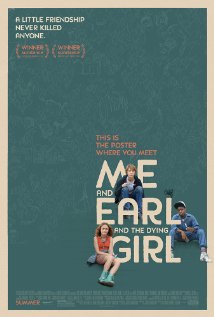
Me and Earl and the Dying Girl. The Criterion product placement masterpiece.

Me and Earl and

Greg is a 17 year old boy whose mother asks (forces) him to befriend Rachel (Olivia Cooke in a role not to unsimilar to the one she plays in the ‘Psycho’ TV spin off series ‘Bates Motel’) who’s been diagnosed with leukemia.
Greg makes low-budget funny versions of classic movies (mainly from the Criterion Collection catalogue) with his friend Earl. ‘A Clockwork Orange’ becomes ‘A Sockwork Orange’, ‘Anatomy of a Murder’ becomes ‘Anatomy of a Burger’ Les 400 Coups’ a.k.a. ‘The 400 Blows’ becomes ‘The 400 Bros’ and so on, not unlike the so-called ‘sweded versions’ in Michel Gondry’s ‘Be Kind Rewind’.
These movies cement the relationship between Greg and Rachel. When the highschool beauty Madison makes Greg promise to make a film especially for Rachel things become more complicated. No more room for escapism, now he and Earl will have to make an original film and will have to face reality.

Due to the subject matter the film is being compared to ‘The Fault in Our Stars’, but ‘Me and Earl and the Dying Girl’ is great cinema, ‘The Fault in Our Stars’ isn’t.
Director Alfonso Gomez-Rejon has worked on the sets of directors like Martin Scorsese, Michael Mann, Sydney Lumet, Alejandro González Iñárritu, … and something definitly rubbed off.
Up to know he’s directed episodes of popular TV series like ‘Glee’ and ‘American Horror Story’ and a brilliantly directed debut ‘The Town That Dreaded Sundown’ (2014), which I’ll be reviewing tomorrow.

If your a cinephile you’ll have a blast with this film. Besides the ‘sweded versions’ of films you’ll constantly notice inside jokes related to movie clips shown (Taxi Driver, Burden of Dreams, … ) and film soundtracks (Vertigo, Navajo Joe, …) used. The film heavily copies the Wes Anderson style of filmmaking (whose entire oeuvre is available on the Criterion label) but without losing an identity of it’s own. This movie has more whip pans than all of Wes Anderson’s films combined (and that’s saying something).

Towards the end the film becomes a bit more sentimental without going to the extremes of ‘The Fault of Our Stars’ though.

Jan Bollen

Slow West: brilliant western starring Michael Fassbender

Slow West

I was genuinely impressed by this bitter sweet neo-western which unfortunately is only receiving a very limited release in Belgium. The film is very confidently directed by John Maclean who prior to ‘Slow West’ only had some music videos (for several of his bands) and a few short films to his credit which were also starring Michael Fassbender. ‘Pitch Black Heist’ (2011) won the BAFTA for best short, you can easily find it on youtube.

Jay ( Kodi Smit-McPhee, the boy in John Hillcoat’s The Road, 2009) is a young Scottish boy who enlists a bounty hunter Silas (yet another excellent performance by Michael Fassbender) for protection and to help find his dreamgirl Rose and her father who had to flee the country. Not realising they have a bounty on their head Jay actually helps Silas to get him closer to his next bounty paycheck. Not surprisingly there are more bounty hunters on the same trail.

On several occasions Jay falls asleep which makes way for dream sequences which function both as a flashback to provide backstory and in a more surreal dreamlike state show us his love and aspirations for Rose.
The fantastic photography by Robbie Ryan (known for the films of Andrea Arnold, and the most recent Ken Loach films) makes great use of the  Scottish and New Zealand locations in an odd 1.66:1 aspect ratio (whereas for westerns you’d expect a cinemascope 2.35:1 ratio)

The film is full of interesting and often gritty characters and details. Despite the duration of less than 85 minutes the film is in no hurry and really takes the time for scenes like the one with the Congolese (french) singers, or the one that shows us an orignal way to dry your clothes. The film shows a lot of respect for and knowledge of the old classics of the genre but uses the familiar situations in a very modern way. The violence is often raw, quick, unexpected and ruthless and Maclean has a wonderful sense of black humor.
Perhaps a bit of an acquired taste but I can’t recommend this film more highly.

Jan Bollen

The first seconds on the road to fame for the 18 year old “Muscles from Brussels” Jean-Claude Van Damme.

Today I’ll be focussing on another film by André Delvaux, ‘Een Vrouw tussen Hond en Wolf’ (Femme entre chien et loup a.k.a Woman Between Wolf and Dog, 1979), which is the first Belgian film to deal head on with the Nazi occupation of our country and the touchy subject of the resistance and collaboration during the Second World War, which is being handle with a lot of delicacy.

The film starts in 1940 in Antwerp and is seen through the eyes of Lieve (Marie-Christine Barrault). She’s married to Adriaan (Rutger Hauer) a flemish nationalist who leaves her behind to serve on the eastern front with the German army . During his absence she’s starting an affair with François (Roger Van Hool) who’s part of the resistance and is hiding in her house, hence the title. The rest you’ll have to discover yourselves.

We don’t really get to see the war which is waging outside, it’s presence is suggested via a masterful use of sound. E.g. there’s a great postcoital scene were we see Lieve and François laying naked on a bed. Suddenly we hear bombs falling in the distance and we get to see close-ups of parts of their body reacting to the sounds of war. One of the wonderfully directed scenes in the film that -deservedly so- make André Delvaux one of our most respected filmmakers.

The film does suffer somewhat from the so-called europudding syndrome. The Dutch actor Rutger Hauer (dutch accent) and French actress Marie-Christine Barrault (dubbed into flemish) are not really ideal to convincingly depict flemish characters.

Apart from that the film really is a who’s who of popular flemish actors that where or would become famous, from Senne Rouffaer (a Delvaux regular) Jenny Tanghe, Janine Bisschops, Johnny Voners, Gene Bervoets, Marleen Merckx, Karel Vingerhoets to the recently deceased Greta Van Langhendonck. There’s also a brief cameo of journalist Johan Anthierens.

And believe it or not it has the very first on screen appearance by Jean-Claude Van Varenberg or the martial artist formerly known as as Jean-Claude van Damme, a.k.a. “The Muscles from Brussels” who must have been about 18 years old at the time the scene was shot. It’s a bit of a scoop as this job as an extra is not mentioned on IMDb, wikipedia, … but judge for yourselves. In the scene in the cinema on the bottom right next to Marie-Christine Barrault sitting on the same row you’ll be able to spot the young JCVD.
Prior to that, about 15 minutes into the film you can actually see the first JCVD ‘fight scene’ with Rutger Hauer no less, look for the soldier at the bottom drinking from a bottle. Nicely directed by Delvaux in a single take.

You can buy the DVD on the Cinematek website.

Jan Bollen