SUBURRA. Excellent Italian gangsterfilm + future Netflix series

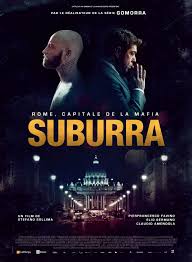
Suburra

Suburra refers to a suburb of Acient Rome and was the title of the novel by Carlo Bonini and Giancarlo De Cataldo on which this film by Stefano Sollima is based. And in case you’re wondering, Stefano is indeed the son of Sergio Sollima (1921-2015), one of the three Sergio’s that were famous for their Spaghetti westerns, the others being Sergio Leone and Sergio Corbucci.

Set in november 2011, the ‘Southern Families’ of the maffia are planning on building the New Las Vegas on the shores of Ostia. An Old School maffioso called ‘Samurai’ (potentially a Jean-Pierre Melville fan) is the man that needs to ensure everybody  stays in line so nothing will prevent the multibillion future cash-cow project from happening.
The Vatican is involved and so is politician Fillipo Malgradi (an excellent Pierfranscesco Favino). When the corrupt Malgredi has a private crack-infused ‘bunga bunga’ with 2 prostitutes of which one is underaged the wheels of fate are set in motion. A countdown of 7 days that will lead to ‘the apocalypse’ has started.

Yet another Italian gangster film you might say and yet it’s a good one. It’s difficult to remain original in a genre that has had many a highlights in the past and in more recent years.
Suburra goes less the realistic docu style way of Gomorra (although there’s some of that as well) but more the architypical way of a Michael Mann. The doomed gangsters looking at a beach behind a big glass window and way the music of M83 is used repeatedly and extremely loud is very reminiscent of Mann. A scene that certainly stands out is the shootout that starts on a back exit stairway of a supermarket and continues in a shopping mall.
The plot is very well set-up and each character gets ample time to play out it’s well-measured role.

By the way Netflix has started production on a TV-series to be aired in 2017 if it’s anything like the film it’s certainly something to look forward to.

Jan Bollen


IN THE HEART OF THE SEA (3D). The story that was the inspiration for Moby-Dick.

In the heart of the Sea

The film is based on Nathaniel Philbrick’s In the Heart of the Sea: The Tragedy of the Whaleship Essex and tells the true story behind the famous novel Moby-Dick by Herman Melville. The film starts with Herman Melville (Ben Whishaw) paying Tom Nickerson (Brendan Gleeson) a handsome sum -basically all the money he has left- to hear him tell his real-life story of what happened on the Essex and in particular their encounter with a gigantic white whale.

What follows are flashbacks showing the very stereotypical rivalry between second in command Owen Chase (Chris Hemsworth reteaming with director Ron howard after the excellent Rush, 2013) and captain George Pollard intercut with scenes of Melville eagerly writing down Nickersons’ tales.
At first Chase and Pollard agree to disagree and are focussing on accomplishing their mission as soon as possible: filling 2000 barrels with oil ‘collected’ from harpooned whales as soon as possible, collect the money and go their separate ways. Untill a giant white whale is crossing their path and sheer survival becomes the order of the day.

The film is very well made, the 3D is not bad but not exceptional either, and the visual effects are very convincing. But that’s the least you can expect from an expensive blockbuster. It’s a good, somewhat old fashioned adventure film with rather simplistic black and white characterisations which somehow never really gives you the impression you’re watching something truly exceptional.

Jan Bollen


VIOLET. Impressive debut by Bart Devos.


We see 2 groups of 2 teenagers on a CCTV (Closed Corner Television) of a small shopping center. One of the teenagers is being attacked. Jesse -who sees his friend Jonas being stabbed and die in front of his eyes- appears  nailed to the ground, unable to react. Suddenly the image starts to rewind and we realise we have been watching these images with several police officers who are investigating the footage that captured the tragic events. We sense a similarity to the Joe Van Holsbeeck killing.

Jesse who’s part of a close group of BMX riders (as was Jonas) has to deal with his own feelings of guilt and with the questions of the rest of the group and his and Jonas’ family.
The film is really a mood piece thriving on atmosphere using a lot of long sequences shots, many of which are cheer magic.  The shot were the camera follows the BMX kids slowly riding in a calm neighbourhood, constantly shifting focus. The shots of them riding and jumping on a track in a forest, following them when they are in the back of a pick-up truck and get on a highway, … . Extremely impressive.

In interviews Bart Devos -who made his feature length debut with Violet- never reveals his inspirations but his film has often been compared with the work if Gus Van Sant and Béla Tarr.
As Violet owes a lot to it’s DoP Nicholas Karakatsanis I believe that the film is at least as much inspired by the work of Gus Van Sant’s regular DoP Harris Savides (1957-2012) then by Van Sant.
It would be interesting to compare the scene in Jonathan Glazer’s Birth (2004), which was shot by Savides, of the arrival in the opera of the character played by Nicole Kidman shortly after she had a somewhat traumatic experience, with a similar scene in Violet during a concert of the black metal band Deafheaven. Both scenes are shot in one single long take in which the camera slowly moves in on the main character to reveal their emotional devastation. No way this shot from Birth wasn’t on the director or the DoP’s mind when they were shooting Violet.

The danger with long sequences shots is that if they do not work the film really falls flat for a moment which luckily does not happen that often. The film is very spare with dialogue and it’s lack of explanation may well alienate or frustrate a large section of the audience.
For me the weakest moments in the film are those when Jesse visits Jonas’ father and we get some Tarkovsky like ‘it’s raining on the inside of a house symbolising the presence of a holy spirit’ scenes which have a really heavy and pretentious feel to them which I’m not a particularly big fan of. But when it works we get to see some magical and original cinematic moments.

Jan Bollen

A VERY MURRAY CHRISTMAS. Christmess.

Murray Christmas

Sofia Coppola reteaming with Bill Murray after Lost in Translation for a Netflix funded good old fashioned Christmas holiday special with guest appearences by George Clooney, Chris Rock, Miley Cirus, Jason Schwartzman, Micheal Cerna, Phoenix, … sounds like it could be a lot of fun. Unfortunately it isn’t. This 56 minute special will disappoint the hell out of a lot of people.

A snow storm has hit New York shutting down the entire city, no subway, no planes, trains or automobiles. No one will be able to attend Bill Murray’s live T.V. show for Christmas eve he fears, a Hollywood agent is desperately trying to sign him, and then suddenly there is a power failure. A wedding party without guests, some hotel staff and a few stranded hotel guests, there’s nothing left for them to do than singing some Christmas songs.

I’m a big Bill Murray fan but his and the talent of a lot of other people are wasted on this Christmas special. The film looks messy, badly shot and edited, it’s like a Robert Altman style film done extremely badly. It looks like it was shot in a couple of days time. The offbeat way the Christmas songs were brought is definitely a positive point and I was extremely charmed by Maya Rudolph and Jenny Lewis, but again, what a mess.

Jan Bollen


MIA MADRE. Nanni Moretti says farewell to his mother.

Mia Madre

Nanni Moretti has never shied away from using autobiographical elements and his sociopolitical views in his films. Moretti’s mother died during post production of his previous film Habemus Papam (We Have a Pope, 2010) With his latest effort Mia Madre he’s made a film in which a female director has to come to terms with her mother’s failing health and potential imminent death while directing a film about a social conflict (an Elio Petri like drama about factory workers on strike against a new Italo American owner) and has to deal with her American lead star (John Torturro, histerically funny at times) who proves to be somewhat difficult.

Moretti has never been that interested in becoming a purely visual filmmaker, his style (or lack of it according to some) is rather modest and certainly not flashy. Interesting in this perspective is one of the earlier scenes in the film where the director Margherita (Margherita Buy playing a female version of Moretti who does appear in the film as the brother) is wondering why one of her camera operators seems to be more interested in/siding with the police beating up the strikers instead of being appalled by the violence he has to film.

Most of the scenes with Torturro as Barry Huggins -who can’t stop telling tall tales of his days on the set of a Stanley Kubrick film, a director everyone in the film knows he’s never worked with- tend to be very funny. He’s more of a tragicomic character who seems to be acting difficult to hide his insecurities and or frustrations he has dealing with the Italian languague/dialogue he does not master.
On the other hand you have very emotional scenes were Margherita does not seem to be willing to accept her mother can’t take a few steps to get to a nearby toilet, or when she realises that all her mother’s life long study and knowledge of the classical languages -which she does pass on to her granddaughter- will disappear with her.
And in yet another -more dreamlike- scene some protagonists are getting in a seemingly endless line around several blocks (little Italian alleys would be more accurate) to go and see Wim Wenders’ Der Himmel über Berlin (Wings of Desire, 1987) in a revival arthouse cinema. ‘They say it’s a great film’ you can here coming from the queue.

It’s difficult to say if the film would have been better served by a purely dramatic approach as Moretti did with his Palme d’or winner La Stanza del Figlio (The Son’s Room, 2001).

Jan Bollen

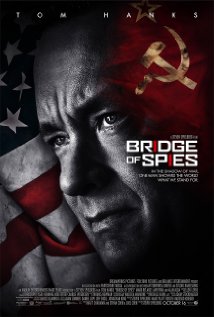
BRIDGE OF SPIES. Exchange of Powers.

Bridge of Spies

The film opens with the FBI following and arresting Rudolf Abel, a sovjet spy in the late fifties, at the height of the Cold War. Tom Hanks plays James B. Donovan a lawyer specialised in insurance cases who’s asked to defend Abel, a case nobody really wants to handle and which does not gain him any popularity.

The ensuing trial is more of a show trial, the outcome is known in advance, Abel is to be found guilty. Donovan is able to prevent Abel to go to the electric chair via some extra-legal arguments. One day the US may be able to use him to exhange him versus an American spy caught by the Ruskies. A first succesful showcasing of Donovan’s intelligence and backroom negociation skills

Slow disolve (classical, but not the most subtle direction by Spielberg) to a young American pilot Francis Gray Powers who’s about to be chosen to go an a secret mission with a U-2 spy plane equiped with the most advanced new cameras to take photographs over Russia where his plane is shot down and he’s captured.
A young American economic student Frederic Pryor is also detained by the east-Germans, literally amidst the buidling of the Berlin wall, the year is 1961.

The time has come to use Rudolf Abel as exchange for at least one of the 2 Americans held behind the iron curtain. The man for the Job, James Donovan in an unofficial capacity.

The direction of Spielberg is very solid, from the first shot he puts his visual mark on the film, no modern day fast cutting but instead a very classical well thought out style of directing. The problem however is that Spielberg cannot help being Spielberg and at times he has to hammer home the message eventhough it’s already been made clear in a more subtle way earlier.
In short the message of the film is: spies are spies and both sides use them, some have honor and are stand-up guys (standing men), others less so and the stand-up patriotic guys deserve our respect. Please note that both sides use coins, either to transport secret messages or to hide a suicide device in case one is caught.

The fim is very entertaining , well written (amongst others by the Coen brothers). The introduction scene of Tom Hanks as an insurance settlement lawyer sets the tone for some similar very crispy dialogue scenes. Mark Rylance (Intimacy and the upcoming Spielberg film The BFG) as Rudolf Abel really has the star part of the film and steals every scene he’s in, it must be the nicest depiction ever of a Russian spy in any movie, certainly one of the more original aspects of the film.

The original score for the film is by Thomas Newman which is somewhat of a rarity as John Williams has done every score for Spielberg starting with The Sugarland Express, Spielberg first studio picture except for The Color Purple which was scored by Quincy Jones who was also one of the producers on that film.

If you read my post and saw the video I prepared a couple of days ago regarding Martin Scorsese’s love for flashbulbs and camera clicks you’ll certainly notice Spielberg’s nod to Scorsese’s The Aviator with the floor of a courtroom hallway covered with used flashbulbs. I’ve prepared a new clip comparing both ‘The Aviator’ and the ‘Bridge of Spies’ scenes + featuring part of the ‘Bridge of Spies’ DGA Q&A Scorsese and Spielberg had and this scene comes up. And as the Coen brothers did some rewriting on the ‘Bridge of Spies’ script they can join in as well.

Below you can find the full interview on the Director’s Guild of America’s Youtube channel:

Jan Bollen


SHINE A LIGHT. Somewhat of a mashup.

A third and (for the time being) last Scorsese video to help bring some attention to the mini Scorsese retrospective being held at Flagey (http://www.cinematek.be/?node=17&event_id=100190101).

We start of with a shot from Shine a Light the Rolling Stones concert film that again shows some flashbulbs and ends with a New York vista (although I did not let the shot play to the end) and you can see Martin Scorsese urging the camera to go up.

Followed by a clip from the Mark Cousins interview with Scorsese for the BBC series Scene by Scene, the bit where Scorsese is referring to his personal lack of technical skills.
Next up, a short clip from After Hours, namely Scorsese director’s cameo. We end with a few seconds from Wes Anderson’s The Life Aquatic with Steve Zissou to make clear this video was supposed to be funny, at least I think it is.

Jan Bollen

Bringing Out the Dead: Scorsese, Mackendrick and (Happy 80th birthday mr.) Woody Allen.

Another film which is being shown 6 times as part of the Scorsese retrospective at Flagey (http://www.cinematek.be/?node=17&event_id=100190101#sthash.3ag9ghCN.dpbs) is Bringing Out the Dead. I’ve prepared a video (a lot shorter than the previous one) featuring 2 clips from a sequence from Scorsese’s Bringing Out the Dead, both preceded by a scene that he’s paying homage to.

We start of with a clip from Sweet Smell of Success, one of Scorsese’s favourite Alexander Mackendrick films. We see Burt Lancaster appear on a huge balcony of a private residence overlooking New York followed by Scorsese’s nod to this scene, this time with Nicholas Cage stepping on a balcony.

Next up, a clip from the opening of Woody Allen’s Manhattan, the fireworks/Gershwin sequence -a nice way for Back to the Cinema to pay tribute to Woody Allen on his 80th birthday- followed by the continuation of the scene from Bringing Out the Dead, Scorsese ending it with some fireworks of his own.

Jan Bollen

Martin Scorsese’s love for flashbulbs and camera clicks.

From 1 till 22 december 2015 a mini restropective of 6 Martin Scorsese films is being held at Flagey. There’s also a Rock Night on 02jan16 with screenings of The Last Waltz and Shine A Light , you can find the complete schedule below:

http://www.cinematek.be/?node=17&event_id=100190101#sthash.eAoAl4hg.dpbs

I’ve prepared the below video showcasing his love for flashbulbs and camera clicks. It shows a lot of examples from Scorsese’s films plus from the films that were a source of inspiration for him.

We start of with Alfred Hitchcock’s Rear Window and Scorsese’s 9 and a half minute commercial The Key to Reserva which is one extended homage to the cinema of the British master of suspense. We single out the flashbulb and blinding effect Scorsese lovingly copied.

Next, a couple of scenes from Fellini’s Otto e Mezzo (8 1/2) and his segment Toby Dammit. (I could have included some scenes from La dolce Vita which features many papparazzi, after all this film invented the term) and some parts of Scorsese’s homage in his Bleu the Chanel commercial entitled The Film (in one minute Scorsese manages to pay tribute to both Fellini and Antonioni’s Blow-Up).
This segment ends with James Gray’s (Little Odessa, The Yards) Bleu the Chanel commercial paying homage to Scorsese’s tribute also using Gaspard Ulliel. Please pay close attention to the short freeze frame of a girl who puts 2 hands on the front windshield of the car mirroring the extended freeze frame with Sandra Bernhard’s hands from the opening of The King of Comedy which is shown later in the clip.

Followed by some more examples from Raging Bull, The King of Comedy, Casino culminating in a highly baroque use of his and editor Thelma Schoonmaker’s editing techinques involving lightbulb flashes and camera clinking sounds in The Aviator. The Aviator is one of the six film you can (re)discover in the retrospective.

We end of the montage with P.T. Anderson’s nod to Scorsese in Boogie Nights, a similar use of the same techniques from an ISIS propaganda film and to end in style an extreme slomo of a lightbulb burnout.

You may notice in some parts the picture and sound are not in synch but there’s nothing I could do to prevent it. One day I’ll make a more professional looking version.

Jan Bollen


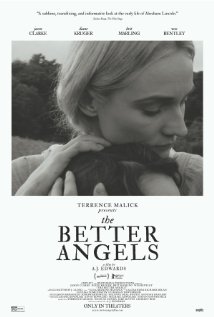
THE BETTER ANGELS. Arthouse minimalist very Malick-like depiction of Abraham Lincoln’s childhood.

The better angels

A completely black screen, and then in white letters appears: All that I am, or hope to be, I owe to my angel mother. Lincoln
A few images of what could be the Lincoln memorial but we never get to see the famous huge Lincoln statue of him sitting in his chair. In the film there’s a young boy called Abe.
The title The Better Angels (2014) refers to Abraham Lincoln’s first inaugural address: “We are not enemies, but friend. We must not be enemies. Though passion may have strained, it must not break our bonds of affection. The mystic chords of memory will swell when again touched, as surely they will be, by the better angels of our nature.

These are the only hints that you’re watching a film depicting several years of childhood of the future president.
I stumbled upon the trailer and after a few seconds I was convinced I was watching the trailer of a new Terrence Malick film. I was wrong but I was not far off.

The film is directed by A.J. Edwards who was camera operator on the making of of Malick’s The New World, and was one of the editors on that film and the subsequent Malick films, The Tree of Life, To the Wonder and Knight of Cups. One of the many producers on the film is none other than Terrence Malick himself.

Now, having seen the film, I can only confirm that the film is pure Malick. The look, feel, atmosphere, use of voice over, the importance nature is given in the film is all 100% identical to Malick. We see children play and a steadycam follows them and lingers on the shadows they leave behind, the camera films a house from the outside and from a little distance while it captures a few slices of life: the list of typical Malick shots and scenes is endless, or is basically the entire film. The only difference is that the film is in black and white.

The film is told via a voice over of the character cousin Dennis Hanks with a heavy southern accent very reminiscent of that of Sissy Spacek in Badlands, or Linda Manz in Days of Heaven or the soldiers in The Thin red Line.
There’s little or no plot, Lincoln’s mother Nancy Hanks Lincoln (Brit Marling) dies of milk sickness, we see the young Lincoln learn to plow and work the field, we see his father (Jason Clarke) a carpenter smooth some wood with a plane, the arrival of new a stepmother (Diane Kruger), some scenes in a classroom with Wes Bentley as the teacher, some slaves in chackels… mostly just little moments that somehow marked the young boy to become the president he went on to become.

The film is very impressive in it’s minimalism and the cinemascope black and white cinematography is great (perhaps there are too many wide angle lense shots as do the recent Malick films), but does not reach to the great heights of the early great Malick films, although it’s far superior to his hugely dissappointing recent efforts To the Wonder and Knight of Cups.
The Better Angels is a very promising debut and has not been picked up by any of the local festivals and received a minimal multiplatform release in the US, so if you which to see it you’ll have to import a DVD. I hope I’ll have the chance to one day see it projected on a big screen to pass a more conclusive verdict.

You can find some of official the trailers below:
http://www.imdb.com/video/imdb/vi372485913/
http://www.imdb.com/video/imdb/vi3164253977/

Jan Bollen