Death Game. (a.k.a. The Seducers) Great talent, not so great a film.

Death Game

Now that Eli Roth’s remake ‘Knock Knock‘ is being released (see previous post) its original ‘Death Game’ (a.k.a. The Seducers) (1977) is getting some attention. Is it a forgotten gem that now finally is getting its due? I’m afraid not.

The film starts of with a message stating: ” This motion picture is based on a true story. It should serve to remind us that fate allows no man to insulate himself against the evil which pervades our society.”
Highly unlikely, in the case of the Coen brothers ‘Fargo‘ we at least knew for sure it was not a serious statement.
The story of ‘Knock Knock’ closely follows that of ‘Death Game’. There are some minor differences, the children are only mentioned in the original but are not seen. The family is absent during father’s day whereas it’s the fathers birthday in ‘Death Game’. The pet has been changed from a cat to a dog and the lady of the house is not an artist, so the house is not covered with her art sculptures. No Iphones, no Uber apps … and the movies resolution differs as well.

It’s interesting to see how many (now) famous people were involved in this project, many of whom may no longer wish to be reminded of it. Except perhaps for the two female leading characters Sondra Locke and Colleen Camp. Sondra Locke is best know for being a former girlfriend of Clint Eastwood, she starred in 6 of his feature films (The Outlaw Josey Wales, The Gauntlet, Every Which Way But Loose, Bronco Billy, Any Which Way You Can, and Sudden Impact) and since their highly publicised break up has done little else. She acts as an executive producer on Roth’s remake.
Colleen Camp has a little cameo in the remake and acts as one of its producers and has had a steady acting career every since, including roles in ‘Apocalypse Now’ and several Peter Bogdanovich films to name but a few.
Bil Paxton -who would later star in several James Cameron films a.o. ‘Aliens’, ‘Titanic’ and blockbusters like ‘Twister’ and directed the solid thriller ‘Frailty’- was assistant set decorator on the film.

The art director on ‘Death Game’ was Jack Fisk, who was art director or production designer on all of Terrence Malick’s films, ‘There Will Be Blood’ and ‘The Master’ by P.T. Anderson and several David Lynch films. Fisk’s wife, the famous actress Sissy Spacek was a set dresser on the film. A job she also had on De Palma’s ‘Phantom of the Paradise’, her husband being the production designer. At the time of ‘Death Game’ she had already played the lead in Malick’s ‘Badlands’ and received an Oscar nomination for best actress for De Palma’s ‘Carrie’, both films for which Fisk did the art direction. Spacek also helped out her husband and David Lynch on ‘Eraserhead’ and would later star in yet another Lynch film, ‘The Straight Story’.

Seymour Cassel who was a John Casseavetes protégé plays the male lead. The voice you hear in the film is clearly not his and was obviously dubbed. I have a sneeky suspicious he’s not to proud of the film even though he’s not that bad in it. Since the early 60’s Cassel can with high regularity be seen on the silver screen and in later years starred in several Wes Anderson films + opposite Sam Louwyck in Tom Barman’s ‘Turnpike’ video.

Jan Bollen
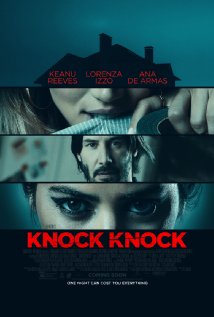
Knock Knock: Who’s That Knocking at My Door, Eli Roth’s remake of Death Game.

Knock KnockDeath Game

On wednesday Eli Roth’s 2013 ‘The Green Inferno‘ will be released in Belgium. His latest film ‘Knock Knock’ (2015) starring Keanu Reeves has only been made available via video on demand (Telenet).

When his family is away for the weekend two young girls, Genisis (Roth’s wife Lorenza Izzo) and Bel (Ana de Armas), ‘happen’ to knock on Evan’s door. They are soaking wet and are looking for help. They were on their way to a party but a taxi has dropped them of at the wrong place. After a slight hesitation Evan invites them in, he gives them robes, puts their clothes in the dryer , makes them a cup of tea and calls them a new cab (via the Uber app).
The girls however were not planning on leaving, they’re on a mission to make his life a living hell, be it a pleasurable one at first. The devout husband, happily married man, with the perfect family and the perfect house may lose it all.

The tone of the movie is hard to discribe as it’s not clear to which extent the filmmakers were taking the film serious. From the get go the ‘happy family’ scenes are bordering on camp and the so-called “free pizza” speech Keanu Reeves delivers towards the end is so funny I can’t imagine it was meant to be taken seriously. The film is not really trying to be scary either and as Eli Roth has a proven track record for horror -Cabin Fever and the 2 Hostel films- that were both horrific and funny, it’s hard to believe he would have lost his touch during the 6 years of his directing hiatus when he was mainly producing films or starring in films by his buddy Tarantino.

When comparing the ‘torture porn’ in ‘Knock Knock’ with that of ‘Hostel parts I & II’, it’s perhaps safer to conclude the film is probably ‘a conscious guilty pleasure about a guilty conscience’. It’s as if John Waters has successfully stolen Eli Roth’s identity. If you were expecting Haneke’s ‘Funny Games’ (1997 or 2007 for the US version ) mixed with Adrian Lyne’s ‘Fatal Attraction (1987) you will be disappointed.
As far as movie references are concerned, the scene were a body is hidden in a paper mache work of art brings to mind Scorsese’s ‘After Hours’ (1985) and a family portrait is hung in a hallway very similar to the famous mirror/portrait in Argento’s ‘Profondo Rosso’ (Deep Red) (1975).

Tomorrow I’ll be reviewing the original ‘masterpiece’ ‘Death Game‘ (a.k.a. The Seducers) (1977) of which ‘Knock Knock’ is a remake (or perhaps a Knock-Off).

Jan Bollen

D’Ardennen. (The Ardennes). Gripping family crime drama.

D'Ardennen_

Sometimes a local film is receiving good press, quite understandably so to support the local film industry even if the film itself is not that good. For instance, check out some of the rave reviews Wim Vandekeybus’ hugely disappointing ‘Galloping Mind’ received. If the critics are losing their credibility when it comes to local films, it’s not a good idea in the long term.
‘D’Ardennen’ (The Ardennes) marks the directorial feature length film debut by Robin Pront and is the latest release from production company Savage Films (Rundskop, a.k.a. Bullhead, and the above mentioned Galloping Mind). There was quite a hype surrounding the film at the time of its release.

After a somewhat slow start there was a short moment I was afraid the hype was not deserved, but there was no reason to. It seemed the movie -like the lyrics of that opening song of Friends- was somewhat ‘stuck in second gear’. But Pront is just taking his time planting seeds and confidently lets scenes play out in single, rather long takes, giving his actors the time to really get into their characters. Once the film reaches the scene in a nightclub where the argument ‘who is the greatest Belgian, Eddy Merckx or Jean-Claude Van Damme?’, is settled once and for all the film really ‘kicks’ into gear.

By then most of the main characters have been introduced. Kenneth (Kevin Janssens) has just been released from prison after solely taking the rap for a bungled home-jacking, that also included his now ex-girlfriend Sylvie (Veerle Baetens) and his brother Dave (Jeroen Perceval, who also wrote the script adaptation based upon his stage play). A love triangle emerges that will be settled in the Ardennes, the location were past joyful family holidays had taken place.

Kevin Janssens (who replaced Matthias Schoenaerts) is really impressive (as is the rest of the cast. To many people his performance will be quite a surprise. A bit like John Ford said about John Wayne after directing him in a rather uncharacteristic emotional scene in ‘The Searchers’ (and after having already worked with him for decades): ‘I never knew the son of a bitch could act.’

The plot is set-up a lot more subtly than is usually the case in these type of crime drama’s. Even when the character Joyce appears, a drag queen played by Sam Louwyck, the tone remains rather serious. Another director might have let things go more over the top. Pront seems to be going more for the dramatic intensity of a James Gray (‘Little Odessa’, ‘The Yards’, … ) or David Michôd’s ‘Animal Kingdom’ than for a more Coen brothers like humorous approach although the end result is somewhere in between. A fine confident debut that makes you yearn for more.

Jan Bollen

Citizenfour. The Oscar winning Edward Snowden documentary.

Citizen4

Is this documentary worth watching if you’ve seen and read all the coverage there has been regarding the Edward Snowden NSA whistleblower story, if surveillance programs like Prism, Echelon, Tempora, Bullrun and so on hold ‘no secrets’ for you anymore? Yes it is.

What was interesting to me is that we get to see the behind the scenes that lead up to the gradual revelations surrounding the secret NSA serveillance programs and the media reaction to it, or better the reactions in the media of the different players involved. The unfolding of history in the making, seen from the Snowden angle and of that of the journalists involved.
At a certain point in the film we get to see the first images in the news of Snowden, the images through which we got to learn about him. We now notice how short they are and how soundbite like they sound compared to the more extensive explanations and reasons Snowden gave for his actions in the part of the documentary leading up to this point.

We see a man who is fully aware of the severe personal consequences his revelations will have on his life. We get to see his constant, in some cases extreme, paranoid behavior. In those instances he’s become a real life version of such fictional characters as Harry Caul (Gene Hackman) the surveillance expert as seen in Francis Ford Coppola’s ‘The Conversation’ (1974)  and Avner (Eric Bana) a Mossad agent in Spielberg’s ‘Munich’ (2005). Characters that with the knowledge and experience they’ve gathered in their professional life know what might be in store for them next.

Anybody who aspires to become a serious journalist should be forced to see Alan J. Pakula’s ‘All the President’s Men’ (1976) ) (depicting The Washington Post’s handling of the Watergate affair), Vincent Garenq’s ‘L’enquête’ (a.k.a. The Clearstream Affair) (2015) and Laura Poitras’ ‘Citizenfour’. The Pakula film to learn what fact checking and double checking is all about and the latter two films to see how to deal with sources and determine how reliable they are, as there’s always the danger of manipulation by a source as the Clearstream affair showed.

The doc. airs on Canvas on 01nov15 at 21h40.

Jan Bollen

Saul fia (Son of Saul). Hungarian Holocaust drama. Focussing on the unfocusable.

Son of Saul

A blurry out of focus 4:3 academy ratio image, we see a shape coming closer to the camera untill the face of the main protagonist, Saul Ausländer, comes into focus. The first shot of the film is not yet over, it continues for several more minutes and sticks to Saul and won’t let go of him for almost the entire film.

Once the camera has locked onto its protagonist the soundscape also starts to capture the increasingly tense atmosphere of the concentration camp where the new arrivals are being brought to the gaschambers. Our protaganist is part of the so-called Sonderkommando, Jews that were forced to help in the camps and thus with the destruction of their own people. The biggest horror remains out of focus while Saul remains up close and in focus, the soundscape fills in what the mostly blurry background is suggesting.

The beginning is like an extremely intense documentary depiction of the daily life (or better, lack of it) in a concentration camp. Jews arriving, undressing themselves , being chased into the gas chambers, being gassed, being dragged dead out of the gas chambers to be incinerated. Their clothes are being searched for valuables, all identification papers are to be destroyed, all signs they ever existed to be erased. The gas chambers are to be cleaned of the puke and excrements that were deficated due to the gassing process so they will be clean again for the next arrivals.

At a certain stage a young boy is found still alive among the dead, only to be suffocated by a german soldier. Saul -although it is suggested he may never have had a son of his own- is convinced the boy is his son and is determined to give him a proper burial. He therefore needs to prevent an autopsy to be performed on the boy (ordered by the german soldier) and the incineration to take place. He also needs a rabbi to say the kaddisj during the burial. A human act during the most inhuman of circumstances.

If the film has any weaknesses it’s during the scenes of some of the unlikely actions and circumstances under which Saul has to undertake his quest. Technically the film is an achievement of the highest cinematic order. The focus puller deserves at least a month of holiday for his superb efforts. The study of its sound design will more than likely become obligatory in many a filmschool. Why this film did not win the Palm d’Or will remain a mystery forever, certainly since the winner ‘Dheepan’ was not the best film Jacques Audiard ever made. It’s probably one of those instances were a director won because he’d been unjustly deprived of the Palm before. Now a future jury will have to undo this injustice, more than likely creating another.

Jan Bollen

The Lobster. Absurdism to the max.

The Lobster

Winner of the Prix du jury at Cannes this year ‘The Lobster’ is Yorgos Lanthimos 4th film. I can’t really recommend his debut ‘Kinetta’ (2005), it’s for completists only.
His second film ‘Kynodontas’ (Dogtooth) (2009) was one of my favorite films of that year. It tells the story of over-protective parents that keeps their children in complete isolation from the rest of the world and was a surprise nominee for the Oscar for best foreign language film. In recent years one of the 5 nominees in this category is being chosen by a specialist panel which explains why films like Rithy Pahn’s ‘The Missing Picture’, ‘Rundskop’ (Bullhead) and ‘Dogtooth’ -which are not your typical Oscar material- ended up being nominated.
His previous film ‘Alpeis’ (Alps) (2011), where people who are grieving rent a replacement for their recently dearly departed, was perhaps more interesting than really good.

The Lobster also has an interesting original premise made up by Lanthimos and Efthymis Filippou, his fixed co-writer since ‘Dogtooth’.
Single people have 45 days to find a partner in some kind of a special resort. If they do not find anyone within that period of time they turn into an animal, be it an animal of their own choosing. David (Colin Farrell) has chosen to become a lobster in case things don’t pan out.
Completely absurd, but the film plays out this premise as straight as you can imagine and the entire cast gives a bravura deadpan performance that would make Buster Keaton jealous. Besides Farrell, you will notice Rachel Weisz, John C. Reilly, Ben Whishaw, Léa Seydoux, Michael Smiley (for all you Ben Wheatley fans out there) and Lanthimos regulars, the greek actresses Angeliki Papoulia and Ariane Labed, who are all in perfect sync with the films special tone.

I could go on for quite a while giving examples of how hilariously absurd this movie is but the less you know about it the more there is for you to discover and enjoy. If you like this film and its absurdism and you’ve already seen the entire Monty Python catalogue many times over be sure to check out the films of the french director Quentin Dupieux, ‘Rubber’ (2010), ‘Wrong’ (2012), ‘Wrong Cops’ (2013) and ‘Réalité’ (Reality) (2014). He even maxes out the absurdity of the above mentioned bunch in an increasingly cinematic way.

The ending of ‘The Lobster’ (don’t worry, no spoiler alert) is remarkably similar to that of ‘Dogtooth’ where both main characters are left in front of a mirror and a washbasin with a ‘painful’ decision to make to be able to move on within the logic of the said films.

Jan Bollen

Beasts of No Nation – A Netflix Original Film. The beginning of the end of theatrical releases?

beasts_of_no_nation_poster

Much is being said about Cary Joji Fukunaga’s ‘Beasts of No Nation’ – A Netflix Original Film. The film itself is perhaps not the masterpiece many are taking it for, even though it’s certainly not bad at all.

Fukunaga adapted the novel by Uzodinma Iweala, produced and directed the film and also was responsible for the cinematography. Previously he directed ‘Jayne Eyre’ (2011) with Mia Wasikowska and Michael Fassbender and the complete first season of the hugely popular ‘True Detective’. The tone of this film however is closer to that of his directorial debut ‘Sin Nombre’ (2009), dealing with south americans trying to cross the Mexican border into the U.S in search of a better life.

Set in an unnamed African country the film follows a child named Agu who gets tangled up in a civil war and is being turned into a child soldier by a character called The Commandant, played by Idris Elba (Stringer Bell in ‘The Wire’), the only name actor in a cast of unknowns.
The movie starts off with children playing in the background seen through the empty casket of a televison set. A couple of  kids try to sell it claiming it’s ‘Imagination TV’. One kid puts his head through it, ‘It’s even in 3D ‘ he says. The film also ends with children playing, this time in an ocean. In between however we get to see the cruelties you can expect to see in a film dealing with such a subject matter.
Whereas an undetermined setting worked perfectly well in e.g. Ingmar Bergman’s ‘Tystnaden’ (The Silence) (1963) and ‘Skammen’ (Shame) (1968) here it creates a distancing effect which I found not helpful for the film at all. The location photography however is aces. Another plus is the above average respect the film shows for other languages (as did the Netflix series ‘Narcos’) which is not always the case in american funded productions and does add to the realism of the film. In the scenes involving the Idris Elba character The Commandant the predominant language is english however.

Simultaneously with the release on Netflix, the film received a limited theatrical release in the U.S. Otherwise it could not be taken into consideration for the Oscars, which is probably the only reason for the theatrical release to begin with. Manny theaters boycotted the film.

When you look at the upcoming movies which Netflix is planning on similarly releasing without necessarily simultaneously releasing it theatrical as well, you can understand the upheavel this is causing for theater chains. On December 11, 2015 it will release ‘The Ridiculous Six’, starring Adam Sandler and Vanilla Ice, a parody on ‘The Magnificent Seven’.
6,7,8 … : So in a short period of time you can see the remake of ‘The Magnificent Seven’ by Antoine Fuqua in theaters, its parody ‘The Ridiculous Six’ on Netflix, and Tarantino’s ‘The Hateful Eight‘ in the cinema’s.
On February 8, 2016 it’s Crouching Tiger, Hidden Dragon II: The Green Legend, the sequel to Ang Lee’s Oscar winning original which will become available on Netflix. The exact release dates are still to be determined for 3 other 2016 Netflix original film productions:
March 2016: Pee-wee’s Big Holiday, starring Pee-wee Herman.
2016: War Machine, directed by David Michôd and starring Brad Pitt.
2016: Special Correspondents, directed by and starring Ricky Gervais.

I personally would be disappointed not to be able to see the David Michôd (‘Animal Kingdom’ & ‘The Rover’) Brad Pitt film on a big screen. Therefore at present time it’s difficult to say if we should give kudos to Netflix for funding a daring project like ‘Beasts of No Nation’ which otherwise might not have seen the light of day, or blame them for trying to disrupt the business model of the competition.

Jan Bollen

Pick of the Week: ‘The Diary of a Teenage Girl’.

Diary of a Teenage Girl@._V1_SX214_AL_

Perhaps the best movie to be released this week is Marielle Heller’s directorial debut ‘The Diary of a Teenage Girl’ based upon Phoebe Gloeckner’s novel of the same title.

Don’t be mistaken by its title, this is not your typical silly mainstream Hollywood romcom with a ‘boy meets girl, boy loses girl and everything ends well’ kind of storyline you can spot from a mile away.
It’s an american indie film with a tone closer to that of Todd Solondz’s ‘Happiness’ (1998) and Sam Mendes’ Oscar winning ‘American Beauty’ (1999) on the one hand and Lars von Trier’s ‘Nymphomaniac’ (2013) on the other, without going to the extremes that von Trier’s film does, even though the film might prove to be provocative for a more prudish audience.

The film is set in 1976 and perfectly captures the seventies atmosphere from the get go, the film just breathes seventies. A masterful achievement of production and costume design which is upheld for the entire film. Brandon Trost won the Cinematography award at Sundance and it’s clear to see why.
Without trying to impress the audience with an establishing shot including a lot of shiny cars of the period, we just see a 15 year old young girl Minnie (brilliant performance by Bel Powley, 22 years old at the time the movie was shot) walking in a park. In a voice-over we hear her say: “I had sex today. Holy Shit”. Shortly afterwards we learn she did not just have sex, she lost her virginity by having sex with her mother’s boyfriend, an excellent Alexander Skarsgård of ‘True Blood’ fame in an risky role. The mother is played by Kirsten Wiig who we usually get to see in more comedic roles.

What makes the film rare is that the coming of age story is told from a girls point of view minus the sweetness and innocence that’s usually associated with this type of story. The film tackles both Minnie’s sexual and artistic awakening. Besides recording her experiences on a tape recorder (the title’s diary) she also likes to draw them, inspired as she is by Aline Kominsky (former partner of that other american drawing legend: Robert Crumb). The film at times combines live action film with animation, but ‘Mary Poppins’ it ain’t. On top the film has a nice well chosen selection of rock songs of the period without opting for the typical obvious tracks you usually get to hear.

The film also has quite a large belgian input. In the opening credits you may be surprised to see the belgian production company Caviar’s name appear. They have opened a Los Angeles office some time ago and have made quite an impressive entry with their first american production. And one of the belgian editors is none less than Marie-Hélène Dozo, the editor of most of the Dardenne brothers’ feature films.

Jan Bollen

Maïwenn’s ‘Mon Roi’: Can’t live with, can’t live without. (review)

Mon Roi affiche

The coming weeks several of this year’s Cannes Film Festival prize winners are hitting our screens. Next week ‘The Lobster’ (Prix du jury) & ‘Son of Saul’ (Grand Prix) will be released and this week it’s up to ‘Mon Roi’ to convince us if the best actress prize was deserved or not.

‘Mon Roi’ (the film has no international title yet,) is the 4th film by Maïwenn (Le Besco). For years she was known as the girlfriend/wife of Luc Besson. The fact that they had a child when she was hardly 17 years old was spread out over many a tabloid. After her child acting years and break-up with Besson she turned away from acting for some time before returning with a vengeance in the director’s chair. As her last 2 films were part of the main selection of the prestigious Cannes Film Festival -which in both cases won a prize- she has made quite a name for herself (in recent years she usually drops her last name Le Besco).

Her three previous films feature a protagonist using (or hiding behind?) a camera. A documentary camera for the semi-autobiographical ‘Pardonnez-moi’ (2006) (Forgive Me) and ‘Le bal des actrices’ (2009) (All About Actresses), a photo camera for ‘Polisse’ (2011) (Prix du jury).
No hiding in this film though, emotions  are running amok. The film starts with a skiing accident of the main character Tony (short for Marie-Antoinette) played by Emmanuelle Bercot. It’s not exactly clear if it really was an accident or a form of deliberate self harming. A bit in the vein of the famous opening scene of ‘Lawrence of Arabia’ where it’s not exactly clear if the main charater had an accident or was committing suicide.

After this opening the movie switches between flashbacks of the meeting and falling in love of Tony and Georgio ( a truly fantastic Vincent Cassel) and scenes of Tony in a rehabilitation center, where her knee injury is being treated. We see Tony being knocked of her socks by the extreme charm and sharp wit of Georgio. There’s a nice scene were Georgio is getting rid of Tony’s sexual insecurity, caused by an insulting remark of a former boyfriend towards the end of a previous relationship, in no time with a few casual funny comments.

The film’s beginning suggests that the good times won’t go on forever. At certain stages of the film a former girlfriend shows up, gradually showing the destructive influence Georgio has on women. Whatever happens -being caught in bed with another woman, drug use, financial difficulties- Georgio always charms his way out of it. When Tony does react it’s usually in front of their friends through extreme emotional outbursts which only seems to lead to more sympathy towards Georgio. And even though she knows their relationship is not healthy she somehow cannot get herself to truly leave Georgio. No wonder ‘Rien ne sert de courir’ (‘No use in running away’) happened to be the working title.

Juxtaposing the rise and fall of a relationship with the physical rehabilitation is slowly but truly suggesting the physical injuries sustained are a desperate cry-out caused by the emotional stress of the marriage. Will Tony ever be able to once and for all get out from under the spell of Georgio?

Emmanuelle Bercot had quite the festival, she directed to opening film ‘La tête haute’ (Standing Tall) and won the best acting prize. It would have been nice if she could have shared it with Cassel as he perhaps delivers the finest performance of his career to date. The way he keeps his character remain charming despite his often despicable actions make the unlikely indecision of the Tony character all the more believable. Only the scenes featuring Tony as a lawyer do not have enough credibility.

Jan Bollen

R.I.P. Maureen O’ Hara (1920-2015) – E.T. likes Maureen.

Hollywood diva Maureen O’ Hara has died at the age of 95. She starred in films of legendary directors as diverse as Jean Renoir (This Land is Mine), Sam Peckinpah (The Deadly Companions), Alfred Hitchcock (Jamaica Inn), Carol Reed (Our Man in Havana), Frank Borzage (Spanish Main) William A. Wellman (Buffalo Bill) Nicholas Ray (A Woman’s Secret) and the only recently being discovered George Sherman (a.o. War Arrow, Big Jake). She’s mostly known however for her collaborations with fellow irish countryman John Ford (5 times) and Hollywood legend John Wayne.

One of those collaborations was ‘The Quiet Man’ (1952). To give a proper send off ‘Back to the Cinema-style’ I’ve used a little clip from Spielberg’s ‘E.T.: the Extra- Terrestrial’ (1982) in which E.T. is watching ‘The Quiet Man’ on television and even shortly interrupts his ‘phone home’ project he has just started. As Elliott is ‘feeling his feelings’ he’s acting out the scene between O’ Hara and Wayne in his
classroom. Please note that the girl Elliott kisses is the young Erika Eleniak of future Baywatch fame.

Jan Bollen