In the coming weeks Cinematek is showing 2 films by one of Belgium’s most respected filmmakers, André Delvaux (1926-2002).
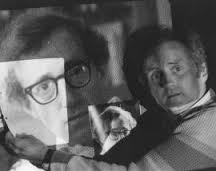
The first film is ‘To Woody Allen from Europe with Love’ (1980) which is a bit of a rarity and is currently not commercially available, and is shown on 19nov15 at 17h00.
(http://www.cinematek.be/?node=17&event_id=400877002)
It’s a documentary Delvaux made for the BRT (flemish television, currently known as VRT) while Woody Allen was shooting ‘Stardust Memories’ (1980) and includes the only footage in existence of Woody Allen filming one of his films. Whenever you see another doc with Allen (e.g. Woody Allen: A documentary , 2012) on a set it’s taken from the Delvaux film.
Allen never gave any crew acces to his sets but Delvaux had a few collaborators in common, his frequent cinematographer the Belgian Ghislain Cloquet also shot Allen’s ‘Love and Death’ (1975) and the actress Marie-Christine Barrault who starred in ‘Stardust Memories’ and had just finished shooting Delvaux’s ‘Een Vrouw tussen Hond en Wolf’ (Woman Between Wolf and Dog, 1979), which probably helped to be granted acces to Allen.
We get to see Allen at home, play the clarinet and behind the editing table. As the film dates back to the early eighties the only Allen films which are being discussed date from the period 1966-1980. This may make the doc a bit outdated as Allen has made some 35 films since, but for real fans it’s a must see none the less. Delvaux frequently draws parallels to refer to specific preoccupations of directors, e.g. he cuts from Allen in New York to himself in Brussels while both are editing their separate films.
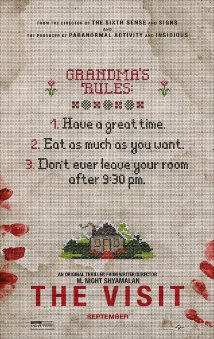
Two kids, Becca and Tyler, go to visit their grandparents for a week. As their mother had a falling-out with them this will be the first real encounter they’ll have with their grandchildren since they were born. The mother does not want to reveal the reason of the rift but does feel the time has come for her children to finally meet her parents, even though she won’t be joining them.
Becca is an aspiring filmmaker and decides to document the visit hoping it will reconcile her mother with her estranged parents. We get to see what happens via the images she and her brother shoot via their mini-cams, making this M. Night Shyamalan’s venture in the seemingly endless found footage horror sub-genre (Cannibal Holocaust, The Blair Witch Project, … ).
Not long after their arrival the grandparents start acting somewhat strange. Are they suffering from an illness like dementia, or the sundowning syndrome or is there a more sinister reason for their behaviour?
What made this film such a pleasant surprise is that Shyamalan injected a lot of humor in what would otherwise have been yet another thriller with cheap scares and a last minute twist. Not that Shyamalan’s film comes even close to Polanski’s ‘Rosemary’s Baby’ (1968) but the combination of horror and comedy works extremely well. So if your afraid to soil your pants, either due to the scares or due to laughter, be sure to wear your diapers.
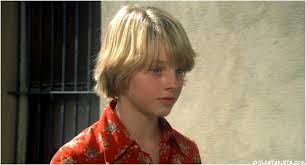
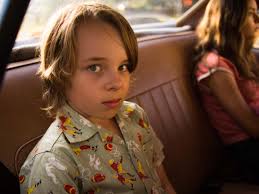
By the way, the young brother Tyler played by Ed Oxenbould is the spitting image of the young Jodie Foster in Scorsese’s ‘Alice Doesn’t Live Here Anymore?’ (1974). Where the Audrey character Foster played in ‘Alice’ was a delicious foul mouth the Tyler character likes to entertain is with some juicy rap lyrics.
Yesterday ‘Friday the 13th Part 13′ took place on the streets of Paris, today I’d like to focus on 2 films that deal with the last moments of the German occupation of Paris in August 1944 that both handle the Dietrich von Choltitz & Raoul Nordling story.
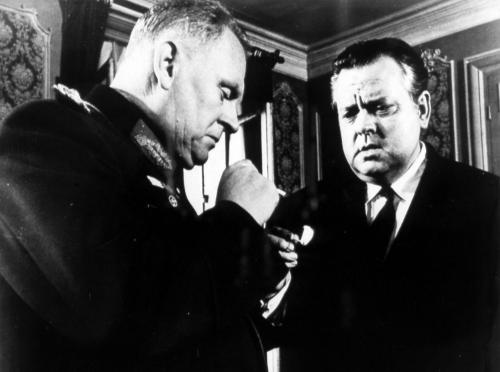
René Clément’s (Jeux Interdits, a.k.a. Forbidden games) ‘Paris brûle-t-il?’ (Is Paris Burning?, 1966) is one of those 60’s big budget productions with “more stars than there are in heaven” as MGM would say in their golden days, a lot of french (Montand, Signoret, Belmondo, Delon, … ) and international stars (Kirk Douglas, Anthony Perkins, George ‘West Side Story’ Chakiris, …).
It tells the story of the French resistance who -knowing the Americans troops are nearing Paris- are trying to recapture their capital from the German occupiers. ‘Brennt Paris?’ is a famous question Hitler asked his Chief of Staff Alfred Jodl as he’d ordered general Dietrich von Cholitz (Gert ‘Goldfinger’ Fröbe) -who had recently been put in charge of Paris- to destroy the French capital. Dynamite was put in strategic places to burn down and flood Paris completely. The Swedish consul-general Raoul Nordling (Orson Welles) had several diplomatic contacts with von Cholitz to prevent him from executing Hitler’s order.
The film was written by Gore Vidal and Francis Ford Coppola (who’d also written another WW II set screenplay for the film ‘Patton’ around the same time).
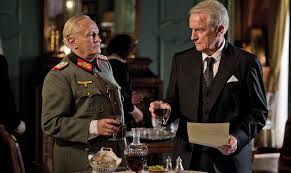
In 2014 Volker Schlöndorff (Die Blechtrommel a.k.a The Tin Drum) made a film called ‘Diplomatie’ (Diplomacy) based upon a stage play by Cyril Gely that depicts the same events.
Schlöndorff’s film focuses soley on the discussions between Dietrich von Cholitz (Niels Arestrup) and Raoul Nordling (André Dussolier) which for dramatic purposes were set during one evening whereas in reality they took place over several days. As Paris still exists we know the outcome of the diplomatic actions beforehand but the film is heavily centered on/interested in the motivations and ethical beliefs of the central characters. At that time, luckily sanity prevailed.
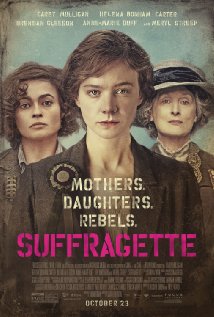
Starting in 1912 and set in England the film shows the increasingly more violent struggle of the so-called women’s suffrage movement (the fight to obtain the right to vote for women and in more general terms to be considered and treated as equal).
Sarah Gavron’s (Brick Lane, 2007) ‘Suffragette’ is one of those typical films about an historically important subject matter that receives the classical BBC treatment (even though they were not envolved in the production).
The costume and production design are spotless, the script neatly checks off all the important historical events it needs to include but in the end you have the feeling that the subject matter deserved a better film.
And so do the actors which are all impeccable in the best British tradition. Carey Mulligan, Helena Bonham Carter, Anne-Marie Duff and the omnipresent Ben Whishaw (The Lobster, Spectre and the upcoming The Danish Girl) to name just a few are all outstanding.
In the above poster you’ll notice that Meryl Streep is prominently featured which is extremely misleading as she only has a brief appearence in the film as the real life historical figure Emmeline Pankhurts, the leader of the British suffragette movement. In the early stages of the film she can be seen in a photograph while the camera pans across a wall, but she actually only has one scene where she gives a speech on a balcony, and that’s it. If Meryl Streep receives an Oscar nomination for best supporting actress for this extremely brief appearence I would seriously suspect ‘electoral fraud’.
Also typical for this type of film is that during the end credits you get to see real historical footage and some additional historical facts that makes you wish you’d seen a documentary on the subject instead. It shows a list of countries and the year in which women received the right to vote, ending with Saudi Arabia where … let’s say the struggle is still continuing.
As Belgium did not feature in the list I’d just like to conclude by stating that in our country women received the right to vote (and to be elected) in 1948 (30 years later than the characters in Suffragette) and they were able to exercise that right for the first time in 1949 when the first general election was held after their right to vote was obtained.
There have been feature length films about World War I since just after the war ended, namely Abel Gance’s in recent years fully restored ‘J’accuse!’ (I Accuse, 1919) and King Vidor’s ‘The Big Parade’ (1925) during the silent era. And also in the early sound era with Lewis Milestone’s Oscar winning ‘All Quiet on the Western Front’ (1930) and the Pabst masterpiece ‘Westfront 1918′ (1930). In later years you had Kubrick’s brilliant ‘Paths of Glory’ (1957), Francesco Rosi’s ‘Uomini Contro’ (Many Wars Ago, 1970) and Tavernier’s ‘Capitain Conan’ (1996) to name but a few.
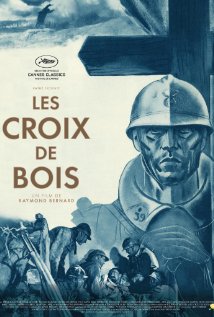
Another major film dealing with WW I film dating from the early sound era is Raymond Bernard’s ‘Les Croix de Bois’ (Wooden Crosses, 1932) beautifully restored in 2014 and released on DVD/ Blu Ray by Pathé in Europe and by Criterion in 2007 in their Eclipse Series, also including Bernard’s 5 hour version of ‘Les Misérables’ (1934) THE version of ‘Les Misérables’ you definitely need to see: 1) it’s great cinema, 2) it has a great actor Harry Baur as Valjean and 3) it has no songs!!!
The film is based on Roland Borgelès’ novel of the same title depicting his real life experiences and that of his comrades during WW I. The Wooden Crosses are off course refering to the many crosses that had to be erected for each fallen soldier. The film is brilliantly shot by Jules Kruger, also responsible for Gance’s legendary ‘Napoléon’ (1927) and Marcel L’Herbier’s ‘L’argent’ (1928) to name but a few of his impressive credits. The footage of the battles scenes were used several years later in Howard Hawks’ ‘The Road to Glory’ (1936), yet another WW I film.
The film has groundbreaking early sound mixing that tries to recreate the sounds of war as realistically as possible, including great use of offscreen sounds of murmuring wounded soldiers.
In the supplementary material (the Pathé discs only) you can find an interesting excerpt from an interview with Bernard discussing the extensive testing they had to do to finally be able to capture the realistic impact of explosions and sounds of machine gun fire by using multiple microphones at once at different distances.
Bernard also explains they’d filmed on the actual locations where the actual WW I trenches had been which at the time of filming were still partly visible. Painfully so, on several occasions they even found corpses of fallen soldiers that could still be identified.
(Billal, Adil and in the middle their main man Spike Lee)
‘Black’ is the second film by Adil El Arbi and Billal Fallah, their debut being ‘Image’ (2014) which was basically a feature film made with the budget for a short film (+/- 120,000 Euro’s). A lot of favours had to be asked for that film to look as good as it did, but it was by no means a fully accomplished film.
The film is based on the novels Black and Back (an excellent cover of Amy Winehouse’s Back to Black by ‘Oscar and the Wolf’ was perhaps to be expected) by Dirk Bracke depicting the street gangs of Brussels. It tells the story of Mavela and Marwan who fall in love when they meet each other in a police station after they’ve both been arrested for stealing some stuff. She’s part of the Black Bronx gang from the Matongé quarter whereas he’s part of the rival Moroccan gang named the 1080’s (being the postal code of Sint-Jans-Molenbeek), The film is basically a raw version of Romeo and Juliet.
The film certainly pulls no punches. Especially the early part of the film which depicts the life of crime and the way the youth is interacting with the police may cause some controversy.
Within it’s rawness their is some subtelty that might get lost if you do not pay close attention. There’s a difference in the way the police with a more local Brussels basckground are depicted compared to police officers that are just doing their obligatory ‘tour of duty’ in Brussels. The film gives an honest depiction that’s not just glorifying violence and crime. There are scenes were e.g. the gang members are enjoying their moment of fame while they’re being arrested by the police. But the way women are being treated is certainly not of a glorifying nature. There’s a particularly brutal rape sequence that people may not expect from ‘the huggable Moroccans’ they’ve become to know from their television appearences.
The actors are amazing. Their “16 rough diamonds” as the directors call them, were found by the specially created Hakuna casting agency that has as a mission to bring diversity and color into Belgian commercials, videoclips and films.
The cinematography by Robrecht Heyvaer, also responsible for D’Ardennen (The Ardennes), is excellent. From a pure directing point of view I was expecting a bit more considering what El Arbi and Fallah pulled of on the shoestring budget they had for ‘Image’. Certainly in the early stages of the film the directing duo was trying to impress us with a loud hip hip soundtrack and a constantly moving camera, not the most original directing I’ve ever seen. The candlelit love scene is somewhat cliché but on the other hand more explicit then you might expect.
However, the way Brussels is filmed, the tense atmosphere that’s created, the ‘no-concession’ attitude with which the films was made and the performances they were able to pull out of a cast of newcomers is no mean achievement.
More so than the films of one of their favourite directors Spike Lee, the tone of the film reminded me somewhat of Boaz Yakin’s ‘Fresh’ (1994) and some of the nicely framed rooftop shots bring to mind Matteo Garrone’s ‘Gomorra’ (2008).
Given the nature of the film it’s not that sure the film will become the success that a lot of people are conviced it will be. So let’s start a nice word of mouth.
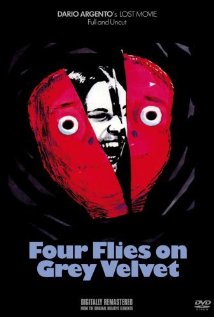
‘Four Flies on Grey Velvet’ (4 Mosche di velluto grigio, 1971) marks Dario Argento’s 3rd instalment of his so-called animal trilogy that began with his directorial debut ‘The Bird with the Crystal Plumage’ (L’uccello dalle piume di cristallo, 1969) and followed by ‘Cat o’Nine Tails’ (Il gatto a nove code, 1971).
Michael Brandon (perhaps best known for his role as Dempsey in the 80’s TV -show ‘Dempsey and Makepeace’) plays Roberto, a musician in a rockband, who’s being stalked by a man wearing sunglasses who he ‘accidentally’ ends op killing while a blackmailer is at the scene to take a photograph of it. A clear reference to Hitchcock’s ‘North by Northwest’ (1959) where Cary Grant is photographed with a knife in his hand standing over a dead body in the United Nations building.
It has one of those insanely, completely ridiculous plots and is filled with trademark Argento visual setpieces that make his giallo films so pleasurable. If you only like films that work on a rational, plausible level please steer away as quickly as you can as it will leave you utterly frustrated. His movies only work if you understand they play in a dreamlike, nightmarish state.
Which could off course be one way of justifying the overall bad acting many accuse him of. It also features Bud Spencer as a buddy of Roberto and Mimsy Framer (Road to Salina and Marco Ferreri’s Ciao maschio). The fact that it’s an Italo-French co-production helps to explain why Jean-Pierre Marielle is also appearing in the film.
I already mentioned Hitchcock and Argento’s hommage to ‘North by Northwest’. To show it’s not the only Hitchcock inspired scene in the film I’ve prepared a clip with the Arbogast (Martin Balsam) murder from ‘Psycho’ (1960) followed by the Argento-like restaging of it for ‘Four Flies on Grey Velvet’.
This brings us to the De Palma connection mentioned in the title of this post. De Palma is one of my favorite directors and one of his is Alfred Hitchcock. As did Argento, he’s learned his craft by studying the masters films and often pays tributes to him (or plainly steals as the De Palma haters would call it) in his movies.
At times De Palma is also accused of ‘borrowing’ from Argento. Even though he confirms the kinship with Argento he is usually dismissive when it comes to being inspired by Argento. In interviews he claims to only really know ‘The Bird with the Crystal Plumage’ well. There are certainly hints of Argento’s debut that can be found in De Palma’s work but usually however fans are refering to the ‘Tenebrae’ (Tenebre, 1982) shot, where a protagonist kneels forward to reveal a killer standing behind him, De Palma copied for ‘Raising Cain’ (1992).
I’ve prepared the below clip with 2 fragments from ‘Four Flies …’ and comparing them with 2 from De Palma’s ‘Dressed to Kill’ (1980). The first has a horizontal split diopter shot from ‘Four Flies … ‘ and a remarkable similar one from ‘Dressed to Kill’. Horizontal split dipoter shots are rare and given the fact that they both feature a step with an object on it make them extremely similar. Technically the De Palma shot is executed far more superior though. (By the way in ‘The Fury’ (1978) De Palma has a marvelous sequence with a bunch of horizontal spit diopter shots one after the other moving in closer on Amy Irving’s face and the electric toy train she’s moving via her telekinetic abilities.)
For the 2nd comparison I’ve severely shortened both the parkbence scene from ‘Four Flies …’ and the museum sequence from ‘Dressed to Kill’ (one of the greatest and most cinematic scenes in movie history in my humble opinion). You will notice a couple of remarkable similarities. If you were to watch both sequences in it’s entirety they have a completely different feel to them but yet, the similarities are undeniable.
There are some more scenes in the Argento film; e.g. where someone is making a blackmail phone call in a phonebooth while the camera pans of to a wire to desolve further to some more wire shots and telephone cables, that bare a resemblance to similar scenes in De Palma’s ‘Blow Out’ (1981) and ‘The Fury’.
‘Dressed to Kill’, even though its clearly more inspired by Hitchcock’s ‘Psycho’ and and the films of Buñuel (mainly Belle de Jour, 1967 and Un Chien Andalou, 1929), has a shot where the killer can be seen during a great crane shot, even though you will only spot on a 2nd viewing, as did Argento in Profondo Rosso (Deep Red, 1975). Though Argento revisits the shot in the end to reveal the killer in his typical fashion. Revisting shots and scenes is also one of the great trademarks of De Palma.
De Palma to me is a far superior director than Argento but perhaps De Palma could perhaps start to give Argento his due where it’s due?
A group of ‘idealistic’ students (‘Don’t think, act!’) go to the Amazon to help safe the rainforest and thus protect the ancient tribes who live there. After their ‘succesful’ mission is completed their small plane crashes and the surviving members end up being captured by a cannabalistic tribe. ‘No good deed goes unpunished’ reads the tagline, indeed it doesn’t.
This is one of those typical horror films the fans will enjoy a lot. It has a lot of inside jokes tthey will have fun spotting. The film itself is an hommage to the Italian cannibal films of the late 1970s and early ’80s, a list of which is even included in the end credits of the film.
Its main inspiration is Ruggero Deodato’s ‘Cannibal Holocaust’ (1980) which even features a film-within-a-film entitled ‘The Green Inferno’. Please note that unlike the Deodato film and films such as ‘The Blair Witch Project’ (1999) Roth’s film is not ‘a found footage horror film’.
The character that takes the lead of the activist student group is called Alejandro (after Jodorowsky?) and the female lead or heroine of the film is called Justine. Considering all the torture and perverted actions she has to undergo the link with Marquis de Sade, and perhaps even more so with the Jess Franco film, is certainly not a coincidence.
Roth fans wil certainly recognise Richard Burgi as Justine’s father the United Nations attorney who played one of the ‘victims’ in ‘Hostel: Part II’ (2007).
As most horror films do, ‘The Green Inferno’ has a lot of ‘serious’ themes it tackles, such as female genital mutilation, the destruction of the rainforest, the corruptibility of social activism and the extreme forms of egotistical behaviour when self-preservation is at stake. These themes are off course just an ironic excuse to have a fun gorefest with scooped out eyeballs, dismemberments and interesting ways of supplying cannabis to cannibals.
After ‘Knock Knock‘ and its original ‘Death Game‘, this concludes our Eli Roth contribution for the week.
With the opening shot of the film, a seemingly one take tracking shot which lasts for several minutes, director Sam Mendes immediately leaves his calling card. In Mexico City amidst the Day of the Dead festivities James Bond accompanied by a woman (no surprise there) follows a man in the partying crowd. When the man enters a building Bond and the woman enter the hotel next door, take the elevator and enter a room and to her surprise instead of making love to her he immediately exits the room via the balcony, casually walks across the rooftop untill he can look into a window of the opposite building where the mystery man he was following re-appears. End of the opening shot.
The entire film is directed with a lot of class and respect for the older Bond films and continously has -at times- rather subtle nods to the entire series. A lot of scenes and circumstances hint at the pre-Daniel Craig Bond films. The main henchman looks like a mash-up of Oddjob and Jack Palance. When you see Ernst Stavro Blofeld you expect to see a cat and low and behold … .
Before the opening shot of the film -as discribed earlier- really gets going the statement ‘The dead are alive’ appears. When you look at the typical highly stylised James Bond opening credit sequence you may briefly spot certain characters that died during the 3 previous Craig Bond films o.a. Vesper, Silva, Le Chiffre and M. The story of the film itself revolves around the criminal organisation SPECTRE (Special Executive for Counter-intelligence, Terrorism, Revenge and Extortion) which might have been active throughout the Craig reboot Bond series without us really knowing about it.
Bond is on a rogue mission -as was Ethan Hunt in episode 5 of the M:I series called Rogue Nation- to hunt down the head of the SPECTRE organisation, and as was the case for the M:I agents the 00 agents are also under threat of being closed down. Modern technology makes blunt tools like the 00 agents obsolete according to a new boss in the UK’s Secret Services world called C.
All the elements you wish (or expect) to see in a Bond film are present, beautiful Bond girls (Léa Seydoux and Monica Bellucci), Miss Moneypenny, Q, a spectacular Bond car (The Aston Martin DB10), a lot of breathtaking stunts and a larger than life villain played by Christoph Waltz.
Waltz is getting one of those old fashioned star entrances: a character everybody is talking about and who’s being feared but it just takes a long time before we actually really get the see him. We first get to see his head from behind during a funeral. In a next scene we get to see his silouette, his face remains in the dark before a sudden turn lights-up half of his face. One of those delightful Sam Mendes directorial touches that give his Bond films (he also directed ‘Skyfall’) that little extra.
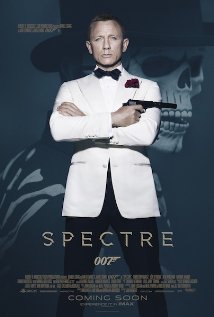
One of the taglines of the film (see poster above) states: ‘What happens to me if I fail your test? The test in question is the so-called Turing test invented by Alan Turing. Last year the movie ‘The Imitation Game’ handled the life, trials and tribulations of Turing’s life. The test basically tries to determine via a set of questions if one of the participants in a conversation is a human being or a machine who can mimic human like responses.
Ridley Scott’s film ‘Blade Runner’ opens with a Turing test gone bad. Other films dealing with the philosophy surrounding Artifical Intelligence, such as Stanley Kubrick’s ‘2001: A Space Odyssey’ and its H.A.L. 9000 ‘character’ and Spielberg’s ‘ A.I.’ (initially also a Kubrick project Spielberg got to make after Kubrick passed away) are using ideas derived from Turing’s writings.
In the film Caleb (Domhnall Gleeson, son of Brendan), after ‘winning’ a competition, is invited by Nathan (Oscar Isaac in yet another high quality product and great as always) -an IT guru- to his remote resort were he is to perform an objective Turing test on AVA. AVA is an A.I. robot with the delightful shape of Alicia Vikander. As Nathan is its creator (the Deus missing from the title), he can not perform it himself. It would be a shame to reveal more of the plot.
If you’re expecting a sci-fi action flick you will more than likely get disappointed as Alex Garland -writer and/or producer on several Danny Boyle films including ‘Sunshine’ and ’28 Days Later’, and the underestimated (Judge) ‘Dredd’ remake- made more of a huis clos psychological drama. Who is really pulling the strings?
Universal Pictures is having a financial miracle year with ‘Jurassic World’, ‘Furious 7’, ‘Minions’, ‘Pitch Perfect 2′, Fifty Shades of Grey’ and the surprise hit ‘Straight Outta Compton’, yet in Belgium they’ve deprived us from a theatrical release of Michael Mann’s ‘Blackhat’ and ‘Ex Machina’. Sad.





 Back to the cinema